
A collection page titled “shred stack” can age-gate a perfectly compliant product in New York. The state’s supplement law covers anything labeled, marketed, or otherwise represented for weight loss or muscle building, and a merchandising decision counts as representation. Your copywriter just wrote checkout logic, and nobody told the checkout.
If you run a supplement brand, that disconnect is where Shopify supplement compliance starts breaking. Your counsel reviews the label and the landing page, your apps run the store, and neither can see the other. It looks like a copywriting problem, but on a working store it’s a systems problem.
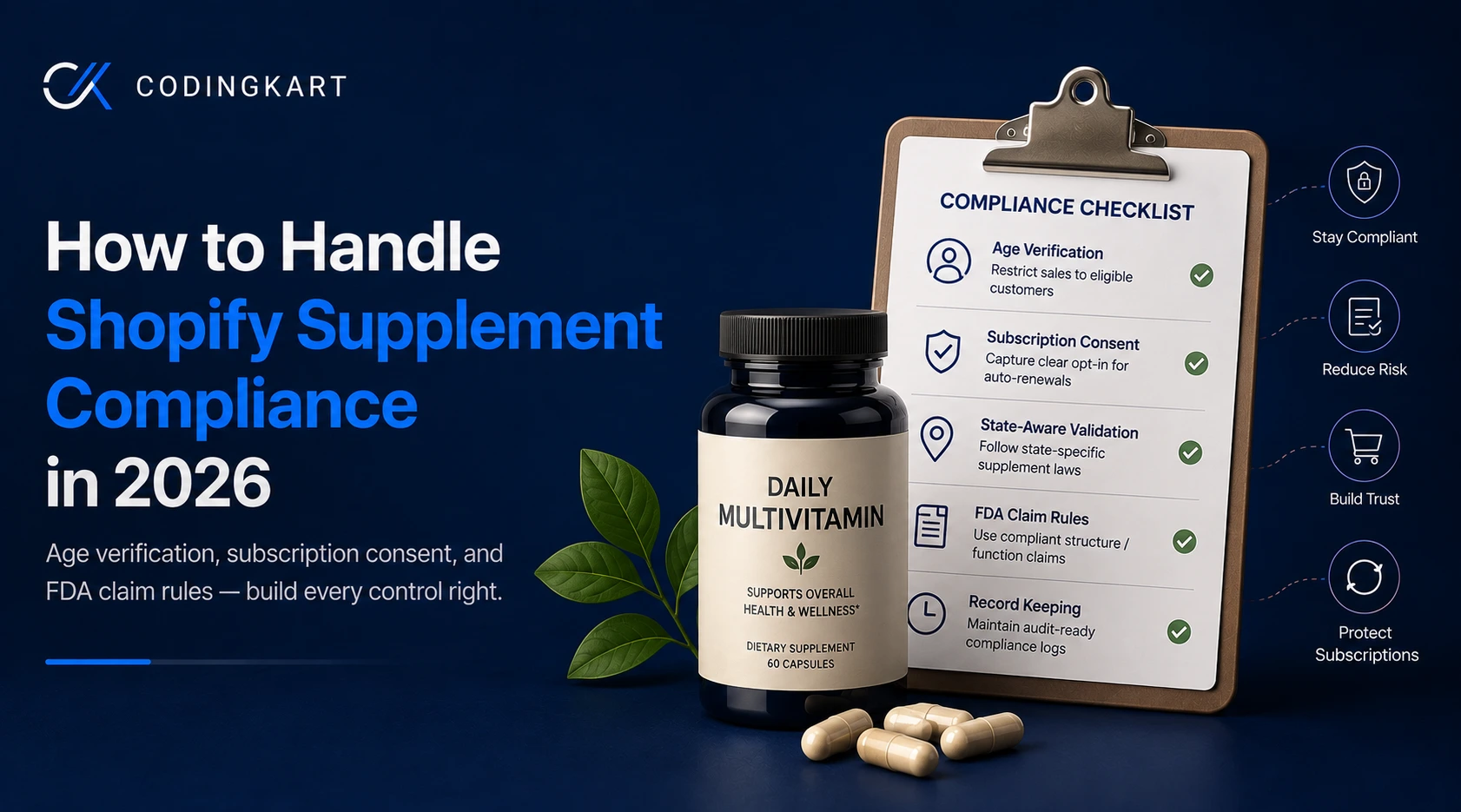
We’ve covered where supplement subscriptions leak revenue through billing mechanics. This is the companion risk map. Four systems close it: a claims pipeline, subscription consent, destination gating, and a records layer.
Three Regulators, One Store
Your product page answers to three regulators, and they don’t compare notes.
The FDA governs labeling, and it treats three claim categories as legitimate for supplements: health claims, nutrient content claims, and structure/function claims. Disease claims sit outside all three, and making one converts your supplement into an unapproved drug in the agency’s eyes. Your product page can function as labeling, so the same rules follow the product online.
The FTC governs advertising, and it leads on substantiation. Its Health Products Compliance Guidance expects claims backed by competent and reliable scientific evidence, and it reads implied claims as seriously as express ones. States now govern the checkout itself through auto-renewal laws, age gates, and warning requirements.
Structure/function claims also carry one procedural duty most small brands learn about too late. You notify the FDA within 30 days of first marketing a product bearing the claim, a filing that tends to surface in warning letters rather than launch checklists.
Here’s the part that matters for your stack: none of the three cares which app generated the claim. The review widget, the quiz result, and the AI-written description all belong to you.
The Claims Surface Map: Every Place Your Store Talks
The label. The product page. The reviews widget, the quiz result, the abandoned-cart email, the meta description. Each one can make a claim, and most of them do it without anyone reviewing the words.
Start with the surfaces you control directly. Product names and PDP copy get legal review at most brands, so the leaks rarely start there. They start one layer out, where content generates itself.
Reviews are the biggest one. A customer writing “this cured my joint pain” is free speech, but the moment you feature that review, republish it, or pull it into an email, regulators read it as your claim. Review moderation for a supplement store needs a claims check, not just a profanity filter.
Quiz flows are the quietest one. A recommendation engine that maps “I feel anxious” to a product has just implied a disease claim, even though no human wrote the sentence. The fix is architectural: quiz outputs draw from approved copy templates, never from free-text generation, the same guardrail discipline we build into quiz-driven recommendation flows in other verticals.
Then come the surfaces nobody audits: meta titles, alt text, SMS flows, affiliate copy. Industry guidance flags even meta tags as regulated claim surfaces, which sounds paranoid until you remember they exist to describe the product.
The line between claim types is narrower than it feels in a copy doc. Supports joint comfort is structure/function, relieves arthritis pain is a disease claim, and the distance between them is one benefit word. AI-drafted descriptions widen the risk, because generative tools reach for outcome language by default and can’t tell the categories apart.
Structure/function claims carry one more requirement wherever they appear. Each needs the federal disclaimer nearby: “This statement has not been evaluated by the Food and Drug Administration. This product is not intended to diagnose, treat, cure, or prevent any disease.” Placing that disclaimer adjacent to every claim it covers, automatically, is a template job, and burying it in the footer is the most common failure we see.
The engineering answer across all of it is a claims-rules layer. Flagged-phrase checks run before publish, reviews route through a claims queue, quiz templates lock, and disclaimer placement automates. Words become governed data.
Subscription Checkout: Consent, Disclosure, and the Rule That Keeps Coming Back
The federal subscription rule is dead. The obligations are not.
Here is the status, as of August 2026. The FTC’s Click-to-Cancel Rule, finalized in October 2024, was vacated by the Eighth Circuit in July 2025 on procedural grounds, so its specific mandates never took effect. Enforcement never paused, because ROSCA and the FTC Act still apply, and the agency has used them against major subscription programs. In March 2026 the FTC opened new rulemaking to rebuild the rule, and roughly 30 states run their own auto-renewal laws, several stricter than the vacated federal version, with California the strictest. The current docket lives on the FTC’s Negative Option Rule page.
The practical read: build to the standard that survives every version. Disclose the material terms clearly before payment, capture express consent to the recurring charge, and make cancellation as easy as signup.
Each of those is an engineering task on Shopify. Disclosure means the selling-plan terms render inside checkout where the buyer sees them, not in a linked footer page. Consent means a checkbox whose state, timestamp, and terms version get stored, because a consent you can’t produce later functions like a consent you never collected.
Cancellation parity lives in the portal, not the support inbox. Several state laws add renewal-reminder emails ahead of long-term renewals, and free trials that convert into paid subscriptions draw the strictest disclosure scrutiny of all. Each requirement resolves into a scheduled job and a template, which means each one is buildable.
One more alignment matters for supplement brands specifically. The disclosed cadence has to match the billed cadence, so if you run dose-timed replenishment billing, a checkout that says “monthly” is describing a subscription you don’t actually sell.
State Age Gates: When a Marketing Word Locks Your Cart
April 22, 2024 changed what a supplement checkout has to know about a buyer’s age.
That’s the day New York’s GBL 391-oo took effect. The law bars selling weight-loss and muscle-building supplements, and over-the-counter diet pills, to anyone under 18. It applies to online retailers shipping into New York, it requires age verification at the time of purchase, and it requires delivery methods where an adult signs and shows ID at the door.
The status is settled enough to build against. The Second Circuit declined to block the law in November 2025, so it stands. Colorado’s version is in effect, New Jersey’s passed its Assembly, and similar bills are moving in California, Massachusetts, Rhode Island, Virginia, and Washington. As of August 2026, a supplement brand shipping nationally is already running a multi-state age-gating problem whether its stack knows it or not.
Now the trigger, which is the part most merchants miss. Coverage follows how a product is labeled, marketed, or otherwise represented, and certain ingredients pull products in on their own, with creatine, green tea extract, and garcinia cambogia among the named examples. A collection title, a quiz result, or a “lean” in the product name can move a SKU into gated territory. Marketing words are checkout logic now.
Here’s what the build looks like. Every SKU carries a restriction-flag metafield schema: an age-gate flag, ingredient flags, a Prop 65 flag. A Shopify Functions checkout validation fires when a flagged SKU meets a New York or Colorado destination, and it either blocks the purchase or requires an age attestation rendered through a checkout UI extension. Delivery customization then restricts gated orders to adult-signature shipping methods.
The attestation itself is a UX decision with legal weight. A checkbox declaring the buyer is 18 or older is the lightest implementation, third-party ID verification is the heaviest, and counsel picks the standard while you control the friction. Whichever level you build, log the attestation against the order the same way you log subscription consent.
Bundles inherit the strictest flag among their components. One creatine SKU age-gates the entire box, which is exactly the kind of component-level rule we covered in supplement bundle logic, now with legal weight behind it.
One operational warning before you scope this: the carriers aren’t ready. Most only offer age verification at 21 rather than 18, adult-signature service costs extra, and free-shipping thresholds break on gated orders. Brands like Cellucor publish entire customer FAQs explaining these mechanics, which tells you how little implementation guidance exists anywhere else.
Design for the states you don’t have yet. If the flag schema stores restrictions as data rather than hard-coding New York, the next enacted state becomes a configuration row instead of a rebuild. The pending bills across five more states make that design choice the cheapest insurance in the whole project.
Prop 65 and the Destination-Aware Product Page
What does California know about your botanical blend?
Quite possibly that it contains a listed chemical. Lead and cadmium occur naturally in botanical ingredients, both sit on California’s Prop 65 list, and products above the safe-harbor thresholds need a clear and reasonable warning. For online sales, the warning has to reach the buyer before the purchase completes, not on the box after it arrives.
Whether you cross the thresholds is a supply-chain question before it’s a display question. Certificates of analysis from your manufacturer answer it per botanical lot, so build the flag to accept per-lot data rather than per-product guesses. The short-form warning format exists for tight layouts, and it still has to be findable.
The engineering rides the same schema as the age gates. A prop65 flag on the SKU drives a destination-aware warning: theme logic surfaces it on the product page for California shoppers, and a checkout-level backstop catches anyone who arrived by a route the theme missed.
One design note from experience. A warning rendered in four-point gray text technically exists and practically invites the professional plaintiffs who make a living finding it. Compliant and visible is the only version worth building.
The Records Layer: Proving It Later
Two years from now, someone asks who approved that claim. What happens next depends entirely on what you kept.
Four records carry the weight. Consent logs pair every active subscriber with a stored checkbox state, timestamp, and terms version. A claim-change audit trail captures who edited which product claim and when, which means CMS versioning wired to an exportable log rather than trusting platform history.
Substantiation files complete the claims side. The FTC’s evidence standard only helps you if the study sits in a file linked to the live claim, findable in minutes rather than reconstructed in a panic. The fourth record is an adverse-event intake path, a monitored contact channel with a documented handling procedure.
Retention windows belong to counsel, enforcement belongs to the system. Ask how long each record type must live, then wire those windows into the storage layer, because a retention policy that exists only in a PDF protects nobody.
None of this is glamorous engineering. It’s the same lesson as every audit trail we build: the record is boring until the day it’s the only thing that matters.
What This Looks Like in a Shopify Build
One metafield schema runs the whole thing.
That’s the unifying architecture. A single set of flags per SKU drives four enforcement points: claims rules at publish time, checkout validation at purchase time, shipping-method selection at fulfillment time, and warning display at render time. Counsel decides what the flags mean, and the stack enforces them everywhere at once.
The named stack, in order: metafields hold the flags, Shopify Functions run cart and checkout validation, checkout UI extensions render consent checkboxes, attestations, and disclosures, delivery customization selects adult-signature methods, and webhooks feed every consent and change event into the audit store. All of it lives in the modern checkout toolchain, the same territory as customizing Shopify checkout for conversion, pointed at obligation instead.
The manual alternative exists, and it has a ceiling. A spreadsheet of restricted SKUs, hand-checked orders, and copy reviews over email can hold for a small catalog and a single state law. It collapses the moment a second state comes online or the catalog crosses a few dozen SKUs, because every new rule multiplies against every SKU.
Sequence the rollout in enforcement order. Flags and claims rules go first because they fix exposure that already exists, then checkout validation, then consent capture, then the records plumbing underneath all of it.
Subscription apps won’t carry this either. The platforms handle billing well and state-specific validation not at all, the same boundary we mapped in Recharge vs custom subscription development, drawn here in regulatory ink.
Already Live? Run the Audit in This Order
Audit in leak order, because the surfaces fail in a predictable sequence.
Claims first: PDPs and product names, then featured reviews, then quiz outputs, then email and SMS flows, then meta titles and alt text. Each pass asks two questions, whether the words cross from structure/function into disease territory, and whether the disclaimer sits next to the claims that need it.
There’s a twenty-minute version worth running today. Search your review widget for cure, treat, heal, and any disease name, then count how many featured reviews come back. That count is the fastest honest exposure measure a founder can get.
Consent second. Pull ten active subscribers at random and try to produce their consent records, terms versions included. If you can’t, the disclosure and capture flow is the next build.
Flags third. Map the catalog against the state laws, bundles included, and mark every SKU that current New York or Colorado rules would gate. Records fourth: the audit trail, the substantiation files, the adverse-event path.
Most of the health and wellness development work we scope now starts with exactly this audit, because it converts a vague compliance worry into a build list. When that list lands on the cart, it becomes Shopify checkout extensions work: validation, attestation, consent capture, disclosure placement. None of this is legal advice, and the division of labor matters, since your counsel decides what the rules require and we build the controls that enforce them.
Measuring Compliance as an Operating Function
Four numbers tell you whether the system works.
Flagged-claim catch rate shows the claims queue doing its job before publish rather than after a letter. Consent-log coverage should read as a percentage of active subscribers, and anything under one hundred is a to-do list. Gated-checkout completion rate by state is the UX signal: if New York conversion collapses after launch, the attestation flow is broken, not the law. Audit findings opened versus closed keeps the whole thing honest.
Then the habit that keeps the whole system honest. Compliance systems age the way compliance information ages, and both are only as good as their last review. Quarterly, on the calendar, with the state-law roster checked each time.
The current triggers worth calendaring: the FTC’s rulemaking outcome, New Jersey’s Senate vote, and whichever state enacts next.
FAQ
Is the FTC click-to-cancel rule in effect?
No. As of August 2026, the rule was vacated by the Eighth Circuit in July 2025 on procedural grounds, but ROSCA and FTC Act enforcement continue, roughly 30 state auto-renewal laws still apply, and the FTC opened rulemaking in March 2026 to rebuild it. Build to the disclosure, consent, and easy-cancellation standard anyway.
Can I sell weight-loss supplements to minors online?
Not into New York or Colorado. Those states bar sales of weight-loss and muscle-building supplements to under-18s and require age verification at purchase, and New York adds adult-signature delivery with ID. Similar bills are moving in several other states.
Where does the FDA disclaimer go on a supplement website?
Next to the structure/function claim it qualifies. Best practice online places the disclaimer adjacent to each claim it covers, mirroring the label requirement, rather than burying one copy in the site footer.
Do product reviews count as advertising claims?
Yes, once you feature or republish them. Regulators treat testimonials a brand amplifies as the brand’s own claims, which is why supplement review moderation needs a claims check and not just a profanity filter.
Does Shopify handle supplement compliance automatically?
No. Shopify provides the primitives, meaning metafields, checkout validation functions, checkout UI extensions, and delivery customization, and the merchant builds the rules on top. No platform setting makes a store compliant.
The durable idea is small enough to keep: one flag, four enforcement points. Get the product data honest and the claims, the checkout, the shipping, and the warnings all inherit that honesty. The brands that treat compliance as configuration will spend the next few years shipping while their competitors spend them explaining.

 Get Started
