
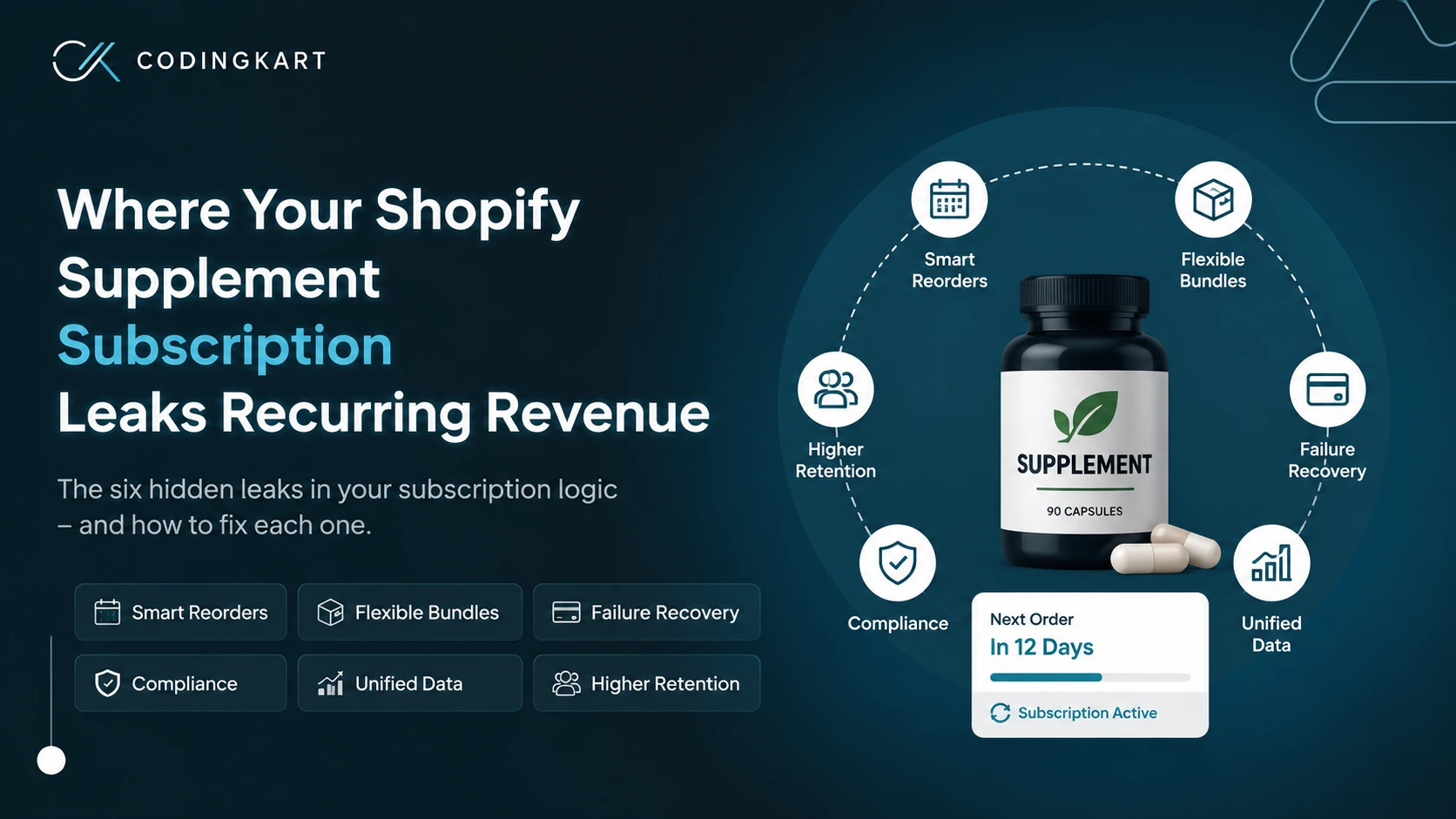
Supplements should be the easiest product to sell on subscription. The bottle runs out, your customer needs more, and the product creates its own demand. No other DTC category starts with that advantage.
So why does your Shopify supplement subscription still lose people every month?
Most brands assume it’s the price or the discount, or that they picked the wrong app. Usually it’s none of those. The revenue leaks in three places that are harder to see: reorders that arrive on the wrong date, bundles that can’t change when a customer’s goals change, and payments that fail quietly.
None of these are marketing problems. They are logic problems, and they live where your subscription app stops. Your app only does what it lets you configure, and once your plans get specific, you hit supplement subscription shopify app limitations no setting will fix.
That’s the frustrating part, because supplements should retain better than almost anything. The market is projected to pass $300 billion by 2028, and replenishment holds subscribers longer than any other model, with around 45% still active after a year.
Yet the brands with the most specific plans keep reaching the same verdict. Kabo, a build-a-box subscription brand, weighed Shopify with Recharge and plugins, judged its plan logic too complex for an app, moved to a custom subscription build. Its published case study reports a 25% lift in average order value.
When the app is not enough, revenue leaks in six specific places, starting with those three.
Why fixed 30/60/90-day reorders make supplement subscribers cancel
Ask a customer why they cancelled a supplement subscription and you’ll often hear the same thing. They had too much. Three bottles stacked in a cupboard, the next shipment already on its way, so they cancelled to stop the pile growing. That’s not a loyalty problem. It’s a math problem your app can’t do.
The over-accumulation problem apps avoid instead of solving
Every subscription app ships the same basic options: every 30, 60, or 90 days. Those intervals are guesses. They have nothing to do with how fast your customer actually goes through the bottle.
A 90-count bottle at two capsules a day lasts 45 days, not 30 and not 60. Set it to monthly and the customer drowns in product. Set it to every two months and they run out for two weeks. Either way you’ve given them a reason to leave.
App vendors know this. One popular subscription app openly advises brands to avoid bundling products with different usage rates, because subscribers over-accumulate and cancel. Read that again. Their fix for the problem is to not sell the bundle. That’s the ceiling of what settings can do, so the advice is to avoid the situation entirely.
How consumption-based reorder timing works
The fix isn’t a better interval. It’s not using intervals at all.
A consumption based subscription calculates the reorder date from the product itself: servings per container, servings per dose, doses per day. That tells you the real depletion date for that specific customer on that specific SKU. Then the next order ships to land just before they run out. Not on a calendar guess.
That’s the difference between calendar reorders and true dose based reorder timing. One assumes. The other knows.
Consolidating a multi-product plan into one shipment and charge
Depletion math creates a second problem, and this is where it gets interesting.
If a customer takes three products that deplete at different rates, honest replenishment would ship them separately, on three dates, with three charges and three shipping fees. Nobody wants that.
So the logic has to do one more thing: track each SKU’s depletion, then consolidate the whole stack into a single shipment on a single date, billed once. That coordination doesn’t exist in an app. It’s custom subscription logic built on top of Recharge, or it doesn’t happen.
Fix the timing and the “I have too much” cancellation mostly disappears. That’s usually the fastest retention win a supplement brand can make.
Why frozen bundles lose customers when their goals change
Nobody subscribes to magnesium. They subscribe to sleeping better.
That gap matters more than it sounds. Your customer didn’t buy a list of SKUs. They bought a goal, and the products are just the current way of getting there. When the goal shifts, they expect the products to shift with it.
Most apps can’t do that, so the customer cancels instead.
Goals change, SKUs should follow
Someone signs up for a sleep stack. Six months later they’re training for a race and they care about recovery now, not sleep. Same person, new goal.
What they want is simple: keep paying, keep the subscription running, just change what’s in the box. What they get from a standard build a box subscription is a dead end. The bundle is a fixed set of products, so there’s no path from the old goal to the new one. Their only option is to cancel the sleep plan and build a recovery plan from scratch.
Half of them won’t bother. That’s a cancellation you caused with a limitation, not a customer you lost to a competitor.
Recomposing a stack without breaking the subscription
The fix is to treat the goal as the thing they subscribe to, and the products as swappable underneath it.
A goal based supplement bundle maps each goal to a set of products. When the customer picks a new goal, or retakes a quiz, the stack recomposes: some products drop, others come in, and the subscription itself never breaks. Same billing date, same cadence, same subscriber. Only the contents move.
Apps don’t work this way because a bundle to them is a frozen SKU group. Letting a customer change subscription without cancelling, mid-stream, while keeping one continuous plan, is logic you build, not a setting you switch on.
Pricing that scales with the stack
There’s a pricing catch hiding in this, and it’s where a lot of custom builds get sloppy.
If products move in and out, the price can’t be hardcoded. A three-product stack and a five-product stack should cost different amounts, and the discount should adjust as the stack grows. Do it right and a bigger stack feels like a better deal, which is the same bundle-and-upsell logic that lifts subscription value in any category.
Sell the goal, not the box, and the subscription survives every change in your customer’s life instead of ending at the first one.
Why your supplement quiz loses subscribers before checkout
The quiz is doing its job. Customers finish it, they trust the result, and then they leave without subscribing.
The drop-off isn’t the quiz. It’s the gap between finishing it and actually subscribing. A quiz app asks the questions and recommends a stack. A separate subscription app runs the billing. Nothing connects the two, so the customer sees their personalized supplement subscription result and then has to go find each product, add it to cart, and set the subscription up by hand. Every one of those steps is a place to quit.
You did the hard part already. You got them to answer honestly and believe the recommendation. Then you handed them a to-do list.
Make the quiz result the subscription, not a suggestion
The fix is to stop treating the quiz result as advice. It should be the plan.
When someone finishes a supplement recommendation quiz, the output shouldn’t be a page of products to reassemble. It should be a built subscription, priced and ready to confirm in one step. The answers become the plan directly, which is the difference between a quiz that recommends and a quiz driven subscription that converts.
The same wiring pays off later. When a customer’s needs change and they retake the quiz, the new answers update the plan they’re already on, instead of handing them a fresh result their live subscription ignores. No cancel, no rebuild.
The claims and cancellation rules your app cannot enforce
Two things can put a supplement brand in real legal trouble, and your subscription app will flag neither. What you’re allowed to say about your products, and how you’re required to let people cancel. Getting either wrong costs real money, in fines, refunds, and chargebacks. Both are supplement subscription compliance, and the app just takes the order.
The claims copy your app won’t check
Supplements fall under DSHEA, which draws a hard line. You can say a product “supports healthy sleep.” You cannot say it “treats insomnia.” One is a structure/function claim, the other is a drug claim, and the FDA treats them very differently.
That language doesn’t just live on the product page. It’s in the quiz result, the reorder email, the bundle description. Any of those is a place someone on your team can write an FDA supplement claim that crosses the line without realizing it.
An app renders whatever copy you feed it. Keeping supplement structure function claims online compliant, at every step of the subscription, is something you build and control, not a box the app ticks.
The auto-renewal reality after click-to-cancel was vacated
This is where most brands are running on old information. The FTC’s 2024 “click to cancel” rule was struck down in 2025, so no single federal click-to-cancel rule is in force today. Plenty of brands read that as the pressure coming off. It didn’t.
ROSCA, the federal law underneath it, is still active, and the FTC is still enforcing it hard, with recent cases against Amazon and Uber. It requires clear disclosure of the recurring terms before you bill, real consent, and a simple way to cancel. Then roughly 30 states layer on their own auto-renewal laws, some, like California, stricter than the vacated federal rule.
The standard didn’t disappear. It fragmented, which is harder to build for, not easier.
Building a cancellation flow that meets the law
Every one of those laws points at the same rule: cancelling has to be as easy as signing up. Subscribe online in two clicks, and you can’t force a phone call to leave.
Most apps hand you a basic portal. A compliant subscription cancellation flow has to satisfy the strictest state you ship to and still sit inside your checkout, which is checkout logic you customize rather than accept as-is. Germany already made this concrete with a mandatory cancellation button. Build to the toughest standard and you’re covered everywhere. Build to the app’s default and you’re exposed exactly where enforcement is heaviest.
The churn that is not a choice: failed cards and dropped habits
Some of your subscribers never decided to leave. Their card expired, the charge failed, and the system quietly cancelled them. They didn’t churn. They got dropped.
Failed payments are a billing problem, not a loyalty one
A big share of subscription churn is involuntary, and it has nothing to do with how the customer feels about you. A card expires, a bank declines a charge, a billing address goes stale. The customer would have happily stayed. The payment just didn’t go through.
Most apps handle this with a blunt retry. The charge fails, it tries again a few times on a fixed schedule, and if those miss, the subscription ends. No attempt to fix why the card failed, just the same charge fired at the same wall.
Recovering these takes actual logic. An account updater catches new card numbers when banks reissue them, so an expired card updates itself before it ever fails. Pre-dunning warns the customer ahead of a charge that’s about to bounce. Smart retries time themselves around paydays instead of guessing. Do failed payment recovery properly and you claw back subscribers you were otherwise losing in silence, which is usually the cheapest supplement subscription retention win available, since you already earned these customers once.
Adherence is a retention lever unique to supplements
The other quiet churn is different. The customer stops taking the product, doesn’t feel anything, and cancels a subscription they’re no longer using.
This one is specific to supplements, and it’s where the consumption model from earlier earns its keep. If you know a customer’s dose and supply, you know roughly when they should be running low, and when they’ve likely fallen off. That timing lets you nudge them to stay consistent before they quit, which protects the results they subscribed for in the first place. An app has no idea whether anyone is actually taking the product. Tie retention to adherence and you’re fixing the real reason people leave, not just the billing symptom.
Where subscription data breaks across your apps and systems
A customer changes one thing. They bump their dose, swap a product, push their next order back a week. Simple on their end. Behind the scenes, that one change has to reach four systems that don’t talk to each other.
One customer change, four systems that must update
Your subscription lives in more than one place. The subscription app holds the plan. Klaviyo holds the email flows. The 3PL holds what actually ships. The ERP holds inventory and the books. When a customer edits their plan, every one of those has to hear about it.
They usually don’t. The app updates, and the rest drift out of sync. Klaviyo keeps emailing about the old stack. The 3PL picks the old contents. The ERP forecasts against numbers that no longer match what people are subscribed to. Now you’re overselling one SKU and sitting on another, guessing at demand that your subscriber base already told you, if only the systems could read it.
No app owns this, because it sits between apps. A layer that keeps your email tool, your 3PL, and your ERP in sync is something you build, so one change lands everywhere at once. That’s the same integration work that connects Shopify to an ERP, applied to a moving subscriber base instead of a static catalog.
Never shipping a subscriber near-expiry stock
Supplements carry a date most products don’t. Every bottle has a lot number and usually an expiry date, and a subscriber getting a bottle that expires in two months notices.
Apps don’t track any of that. They pick whatever’s on the shelf. Real batch tracking for supplements means the system knows each lot’s expiry and ships first-expiry-first-out, so the oldest stock moves first and never lands with a recurring customer. FEFO fulfillment is standard thinking in a warehouse. It’s just absent from the app deciding what goes in the box. Build it in, and you stop quietly sending your most loyal customers your most expired stock.
Most supplement brands don’t outgrow their app because they got something wrong. They outgrow it because they got something right. More products, more specific plans, real personalization, customers who stay long enough to have changing needs. Success is what breaks the app.
That’s the quiet trap. The better your subscription gets, the more its logic outruns what a settings page can express, and the leaks in this piece are just where that gap shows up. A Shopify supplement subscription at that stage isn’t a configuration problem anymore. It’s a build.
Common questions about Shopify supplement subscriptions
Is a subscription app enough, or do you need custom development?
An app is enough when your subscription is simple: one product, one cadence, standard skip and pause. You need custom development once the logic gets specific, like reorder timing tied to real consumption, goal-based bundles that recompose, or compliance rules an app cannot enforce. The trigger is the point where working around the app costs more than building the fix.
Why do supplement subscribers cancel?
The most common reason is too much product. Fixed 30, 60, or 90 day intervals do not match how fast someone finishes a bottle, so subscribers over-accumulate and cancel to stop the pile growing. A large share also leave involuntarily, through failed cards the system never recovers, rather than by choice.
What is the difference between voluntary and involuntary churn?
Voluntary churn is when a subscriber actively cancels, usually over price, timing, or getting too much product. Involuntary churn is when the payment fails, an expired card or a bank decline, even though the customer wanted to stay. They need different fixes: voluntary churn needs flexibility and better timing, involuntary churn needs smart payment recovery.
Does the FTC click-to-cancel rule still apply to supplement subscriptions?
The federal click-to-cancel rule was struck down in 2025, so no single federal rule is in force right now. You still have to make cancelling as easy as signing up, because ROSCA and roughly 30 state laws require it and the FTC is actively enforcing them. Building to the strictest state you ship to keeps you covered.
What is a good churn rate for a supplement subscription?
Many Shopify subscription brands see monthly churn around 5%, which compounds to roughly 46% over a year, while the strongest hold it under 3%. Supplements should sit on the better end, because the product runs out and creates its own repeat demand. If your churn is high despite that, the cause is usually reorder timing, rigid plans, or failed payments, not your discount.

 Get Started
