
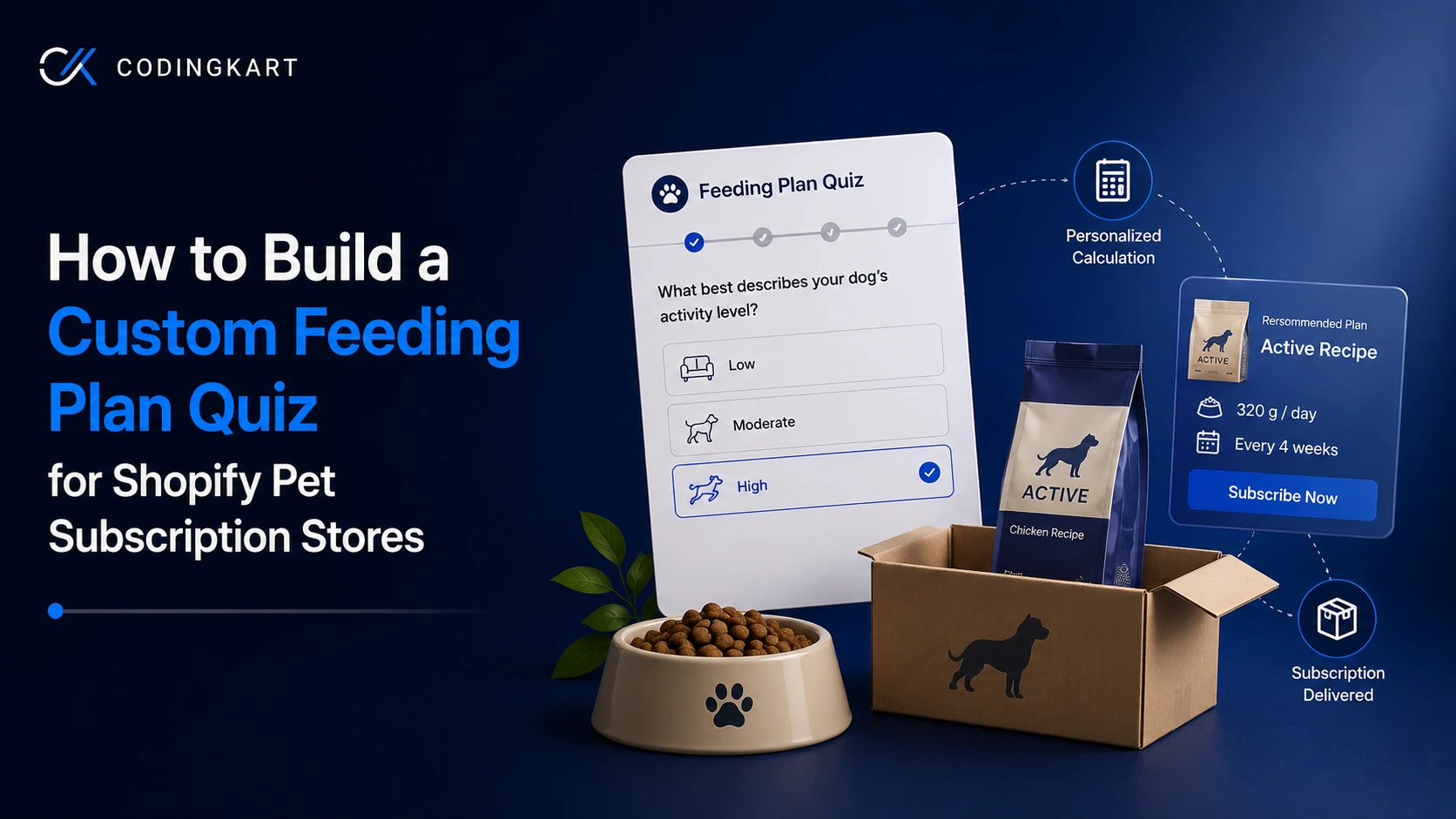
The harder part is determining how much food a pet actually needs and turning that recommendation into a recurring order using a custom feeding plan quiz for Shopify pet stores combined with a well-designed shopify subscription workflow.
That’s where standard product recommendation quizzes begin to fall short.
While they can match customers with suitable recipes, they aren’t designed to calculate daily feeding requirements, adjust subscription quantities, or adapt recommendations as nutrition guidelines change.
A custom feeding plan quiz goes beyond product matching. It combines customer inputs, nutritional calculations, and subscription logic to create recommendations that are practical for both the pet owner and the business.
The architecture behind that experience is what determines whether the solution remains easy to maintain as your product catalogue, pricing, and feeding rules evolve.
Why Product Recommendation Quizzes Aren’t Enough for Pet Subscription Stores
At first glance, a feeding plan quiz doesn’t seem much different from any other Shopify product recommendation quiz. Customers answer a few questions, receive a recommendation, and continue to checkout.
The similarity ends there.
A product recommendation engine is designed to answer one question: Which product should this customer buy?
A feeding plan has a much broader responsibility. It needs to estimate daily food requirements, identify suitable recipes, calculate how much food should be delivered, and determine the subscription quantity that supports those feeding requirements.
These aren’t simple conditions that point to a product. They’re connected calculations where a single change, such as a pet’s activity level or weight, can affect calories, portion sizes, monthly deliveries, and recurring pricing.
This is why many pet subscription brands eventually outgrow standard quiz builders. The limitation isn’t the questions they can ask. It’s the business logic they can support.
Personalization Has Changed Customer Expectations
The role of a feeding plan quiz has changed significantly over the last few years. Customers no longer expect to browse a catalogue, compare recipes, and calculate feeding quantities on their own. They expect the store to guide them toward the right choice based on their pet’s individual needs.
For merchants, this shift creates an opportunity to simplify the buying journey while collecting information that remains valuable long after the first purchase. Details such as age, breed, activity level, allergies, and health goals can support future subscription updates, personalized recommendations, and customer retention strategies.
More importantly, the quiz establishes context before any product is shown. Instead of asking customers to choose between multiple recipes, the application narrows the decision based on nutritional requirements. The recommendation feels more relevant because it’s backed by the information the customer has already provided.
Recommendations Are Only One Part of the Solution
Building the questionnaire is rarely the difficult part. The real challenge begins once the customer submits their answers.
Imagine a pet owner updates their dog’s activity level from Moderately Active to Highly Active. That single change can influence several parts of the subscription journey. Daily calorie requirements increase, portion sizes need to be recalculated, the recommended monthly quantity changes, and the recurring subscription may require a different billing amount.
None of these decisions should be handled independently. They’re part of the same calculation process, where one customer input affects multiple business rules at the same time.
This is why feeding plan quizzes quickly move beyond traditional product recommendations. The quiz collects information, but the recommendation is created by the logic working behind it.
Every Question Should Lead to a Business Decision
A well-designed feeding plan quiz isn’t measured by the number of questions it asks. It’s measured by how effectively those answers shape the final recommendation.
Every question should trigger a business decision. If the answer doesn’t influence calories, recipe eligibility, portion sizes, pricing, or subscription quantities, it adds friction without adding value.
Consider a customer’s activity level. That single answer might increase daily calorie requirements, which changes the recommended feeding quantity and ultimately affects how much food should be delivered each month. In other words, one input can influence several downstream decisions.
Looking at the quiz through this lens changes the design process. Instead of building a questionnaire, you’re designing a decision engine that happens to use questions as its interface.
Build the Quiz Around Decisions, Not Data Collection
Most feeding plan quizzes collect information such as:
- Pet type
- Breed
- Age
- Weight
- Activity level
- Body condition
- Dietary preferences
- Allergies
- Health goals
The difference between a basic quiz and a custom feeding plan isn’t the list itself. It’s what happens with those answers.
A well-designed system turns customer responses into business decisions.
| Customer Answer | What It Should Influence |
|---|---|
| Weight | Daily calorie requirement |
| Activity level | Portion calculations |
| Age | Nutritional rules |
| Allergies | Recipe availability |
| Health goals | Ingredient selection |
| Number of pets | Subscription quantity |
Looking at the quiz this way changes the entire implementation.
You’re no longer building a form.
You’re designing the decision-making process that powers the subscription.
Keep the Customer Experience Separate from Business Logic
Another decision has a much bigger impact than many merchants expect.
Where should the feeding calculations live?
During early development, it’s tempting to place everything inside the quiz because it’s quicker to launch. That approach works until something changes.
- Nutrition guidelines evolve.
- Recipes are updated.
- Subscription pricing changes.
- New products are introduced.
When the calculation rules are tightly coupled with the quiz, even small updates become time-consuming because every change affects the customer-facing experience.
A more maintainable approach keeps the quiz focused on collecting information while the application processes nutritional calculations separately before sending the final recommendation to Shopify. That separation allows merchants to adjust formulas, pricing rules, or recipe eligibility without redesigning the quiz every time the business evolves.
This becomes particularly important for subscription businesses where feeding plans may need to change throughout a customer’s lifecycle rather than remaining fixed after the first purchase.
The Calculation Engine Is the Real Foundation of a Feeding Plan Quiz
The success of a feeding plan quiz isn’t determined by the number of questions it asks. It’s determined by what happens after the customer clicks Continue.
Every answer collected during the quiz should contribute to a recommendation that’s both nutritionally accurate and commercially practical. That’s why successful implementations rely on a calculation engine instead of a long list of conditional rules, similar to how custom Shopify apps handle complex business logic beyond standard store functionality.
Think about the decisions a pet food brand has to make before displaying a recommendation. The application needs to estimate daily calorie requirements, identify recipes that meet those nutritional needs, calculate how much food should be delivered, and create a subscription that matches the customer’s expected consumption.
Those decisions are connected. Changing one variable often affects several others.
From Customer Answers to Daily Feeding Requirements
Let’s take a simple example.
A customer enters the following information:
- Dog
- 12 kg
- Adult
- Highly active
- Chicken recipe preferred
A standard quiz might recommend a chicken-based recipe and send the customer to the product page.
A custom feeding plan goes several steps further.
The customer’s weight and activity level are first used to estimate daily calorie requirements. That calorie target is then matched against recipes that fit the pet’s nutritional profile. Once the recipe has been selected, the application calculates the daily feeding quantity and uses that value to determine how much food the customer should receive each month.
The recommendation isn’t based on product preference alone. It’s based on the amount of food the pet is expected to consume.
This distinction becomes increasingly important as subscription businesses grow because customers aren’t buying a single bag of food. They’re buying an ongoing feeding plan.
Product Data Should Support the Recommendation
The calculation process also needs access to reliable product information.
Depending on the business model, that might include:
- Calories per serving
- Ingredient composition
- Package size
- Inventory availability
- Subscription eligibility
- Pricing
Rather than hardcoding these values into the quiz, many custom implementations reference Shopify product data so recommendations stay aligned with the catalogue.
For example, if a recipe is discontinued or a new formula is introduced, the recommendation engine should automatically work with the updated product information instead of requiring the quiz to be rebuilt.
This approach reduces maintenance and keeps merchandising, operations, and customer experience aligned.
Recommendations Should Stay Flexible
A feeding plan shouldn’t become outdated the moment a customer completes the quiz.
Pets gain weight. Puppies become adults. Senior dogs may require different nutrition. Subscription quantities and delivery schedules may also need to change as feeding requirements evolve, which is why pet subscription delivery timing becomes an important part of the overall feeding experience.
A flexible implementation makes it possible to adjust future recommendations without forcing customers to complete the entire onboarding process again.
That’s one reason growing brands avoid embedding all their nutrition rules inside a quiz builder. Separating customer inputs from calculation logic gives the business room to evolve without redesigning the experience every few months.
Connecting the Feeding Plan to Shopify
Once the feeding plan has been calculated, Shopify becomes responsible for turning that recommendation into a purchase. This approach is becoming increasingly common among brands building pet food subscription experiences on Shopify, where personalization and recurring ordering work together.
This is the point where many projects shift from frontend development to application architecture.
The feeding plan already knows which recipe the customer needs, how much food should be delivered, and how frequently deliveries should occur.
The remaining task is translating those decisions into Shopify’s commerce model.
Using Shopify as the Commerce Layer
Shopify is excellent at managing products, orders, customers, and recurring purchases.
It isn’t designed to calculate nutritional formulas.
Trying to move all nutrition logic into Shopify usually creates unnecessary complexity because every change to feeding rules becomes a storefront change.
Instead, many custom implementations use Shopify for what it does best:
- Displaying products
- Managing customer accounts
- Processing checkout
- Storing product information
- Creating recurring purchases
The feeding logic remains independent, while Shopify handles the commercial side of the customer journey.
That separation makes future updates far easier to manage.
Managing Dynamic Subscription Quantities
One of the biggest differences between a standard subscription store and a personalized feeding plan is quantity.
Most subscription products have fixed quantities. A personalized feeding plan rarely does, because the quantity may need to change based on customer preferences, usage patterns, or product requirements.
If a customer’s pet requires more food after a recalculation, the subscription may need to deliver a larger quantity during the next billing cycle.
Likewise, changes in weight management goals or activity levels may reduce future deliveries.
Supporting this type of flexibility requires subscription quantities to be generated from calculated feeding requirements rather than predefined product bundles. In these situations, brands often extend their subscription setup through custom Recharge integrations to connect unique business rules with recurring orders.
That’s one reason many pet food brands eventually outgrow simple subscription configurations.
Choosing Between Recharge, Skio, and Custom Logic
Recharge and Skio both provide reliable subscription management for Shopify stores. The choice depends on whether your business needs simple recurring billing or a more personalized subscription workflow connected to external calculations. However, when subscription requirements involve personalized rules, dynamic quantities, or custom customer journeys, brands often need to evaluate whether standard subscription tools are enough or if they require a more customized approach.
They handle recurring billing, customer subscription management, and delivery scheduling exceptionally well.
What they don’t do is calculate nutrition.
That responsibility usually belongs to the application sitting before the subscription platform.
A practical way to think about the architecture is this:
- The quiz collects customer information.
- The calculation layer determines the feeding plan.
- Shopify prepares the products for purchase.
- Recharge or Skio manages the recurring subscription after checkout.
Giving each system a clear responsibility results in a solution that’s easier to extend as the business grows.
When Off-the-Shelf Quiz Apps Stop Being Enough
Shopify’s app ecosystem offers several quiz builders that work well for simple product recommendations. If your goal is to guide customers toward a product based on a few preferences, these apps can help you launch quickly.
The challenge begins when recommendations become calculations.
A feeding plan often depends on multiple variables working together. Changing a pet’s weight, age, or activity level doesn’t just influence the recommended recipe. It can affect portion sizes, subscription quantities, pricing, and delivery frequency. Managing these relationships with conditional logic alone quickly becomes difficult.
Another consideration is long-term maintenance. As your business evolves, you’ll likely introduce new recipes, update nutritional guidelines, adjust pricing, or expand your subscription offerings. If all those rules are embedded within the quiz itself, even routine updates become increasingly time-consuming.
For growing brands, it’s usually more sustainable to treat the quiz as the customer interface while keeping business rules independent. That separation makes it easier to improve one part of the system without disrupting the entire customer journey.
When a Quiz App Is the Right Choice
A standard Shopify quiz app is often enough if your store:
- Recommends products without nutritional calculations
- Offers fixed subscription plans
- Has a relatively small product catalogue
- Doesn’t require dynamic pricing or portion calculations
For businesses in this stage, speed and simplicity often matter more than advanced customization.
When Custom Development Makes More Sense
Custom development becomes a stronger option when your feeding plans depend on calculations rather than fixed rules.
Typical examples include:
- Personalized calorie and portion calculations
- Dynamic subscription quantities
- Multiple recipes based on nutritional goals
- Custom pricing based on feeding requirements
- Integration with external nutrition systems
- Ongoing feeding plan updates throughout a customer’s subscription
At this stage, you’re no longer building a product recommendation quiz. You’re building a personalized subscription workflow.
Key Considerations Before Building a Feeding Plan Quiz
Before selecting a quiz app or planning a custom solution, it’s worth answering a few practical questions.
Will feeding recommendations change over time?
If nutritional formulas or recipes are updated regularly, the system should allow those changes without requiring a complete rebuild.
Does every question influence the recommendation?
Avoid collecting information simply because it seems useful. Every answer should affect calculations, recipe selection, pricing, or subscription logic.
How will subscriptions adapt as customer needs change?
A feeding plan shouldn’t remain static. Pets grow, activity levels change, and nutritional requirements evolve. Planning for those changes early makes the platform easier to maintain.
Can the solution scale with the business?
Many merchants launch with a simple quiz and gradually introduce personalized subscriptions. Choosing an architecture that supports future growth helps avoid expensive redevelopment later.
Thinking through these questions before development begins often saves far more time than trying to solve them after launch.
Building a feeding plan quiz for a Shopify pet subscription store is about far more than collecting customer information.
The real value lies in what happens after the customer completes the questionnaire.
A well-designed solution transforms pet data into meaningful recommendations by calculating feeding requirements, matching suitable recipes, and creating subscription plans that reflect how much food the customer actually needs.
As the business grows, those calculations become increasingly important. Recipes change, nutritional guidelines evolve, and subscription models become more sophisticated. Keeping the quiz separate from the business logic makes those changes easier to manage while providing customers with a consistent experience.
For brands looking to offer truly personalized pet nutrition, the quiz is only the beginning. The real advantage comes from the system working behind it.
Frequently Asked Questions
Can Shopify calculate feeding plans on its own?
Shopify manages products, customers, and orders exceptionally well, but it isn’t designed to calculate nutritional requirements. Most personalized feeding plans rely on custom business logic that works alongside Shopify rather than inside it.
Are Shopify quiz apps suitable for pet food subscriptions?
They can be a good starting point for product recommendations. However, stores that require calorie calculations, portion sizing, or dynamic subscription quantities often benefit from custom development.
Can feeding plan recommendations update existing subscriptions?
Yes. A custom implementation can recalculate feeding plans as customer information changes and update future subscription quantities accordingly, depending on the subscription platform and business requirements.
Which subscription platforms work with Shopify pet stores?
Many Shopify pet brands use platforms such as Recharge or Skio to manage recurring orders. These platforms handle subscription management, while custom business logic calculates feeding recommendations.
Is custom development worth it for smaller pet brands?
It depends on your business model. If you’re offering fixed subscription plans, a standard quiz app may be sufficient. If personalization is central to your customer experience, investing in a custom solution early can provide greater flexibility as the business grows.
A custom feeding plan quiz isn’t just another feature on a Shopify store. It’s often the engine that connects customer data, nutritional recommendations, subscription management, and long-term retention.
Brands that invest in this experience aren’t simply making product recommendations. They’re building a subscription journey that feels tailored to every pet while creating a system that’s easier to scale as the business grows.
If your goal is to deliver personalized pet nutrition rather than generic product suggestions, designing the right architecture from the beginning will have a far greater impact than choosing the right quiz app.

 Get Started
