
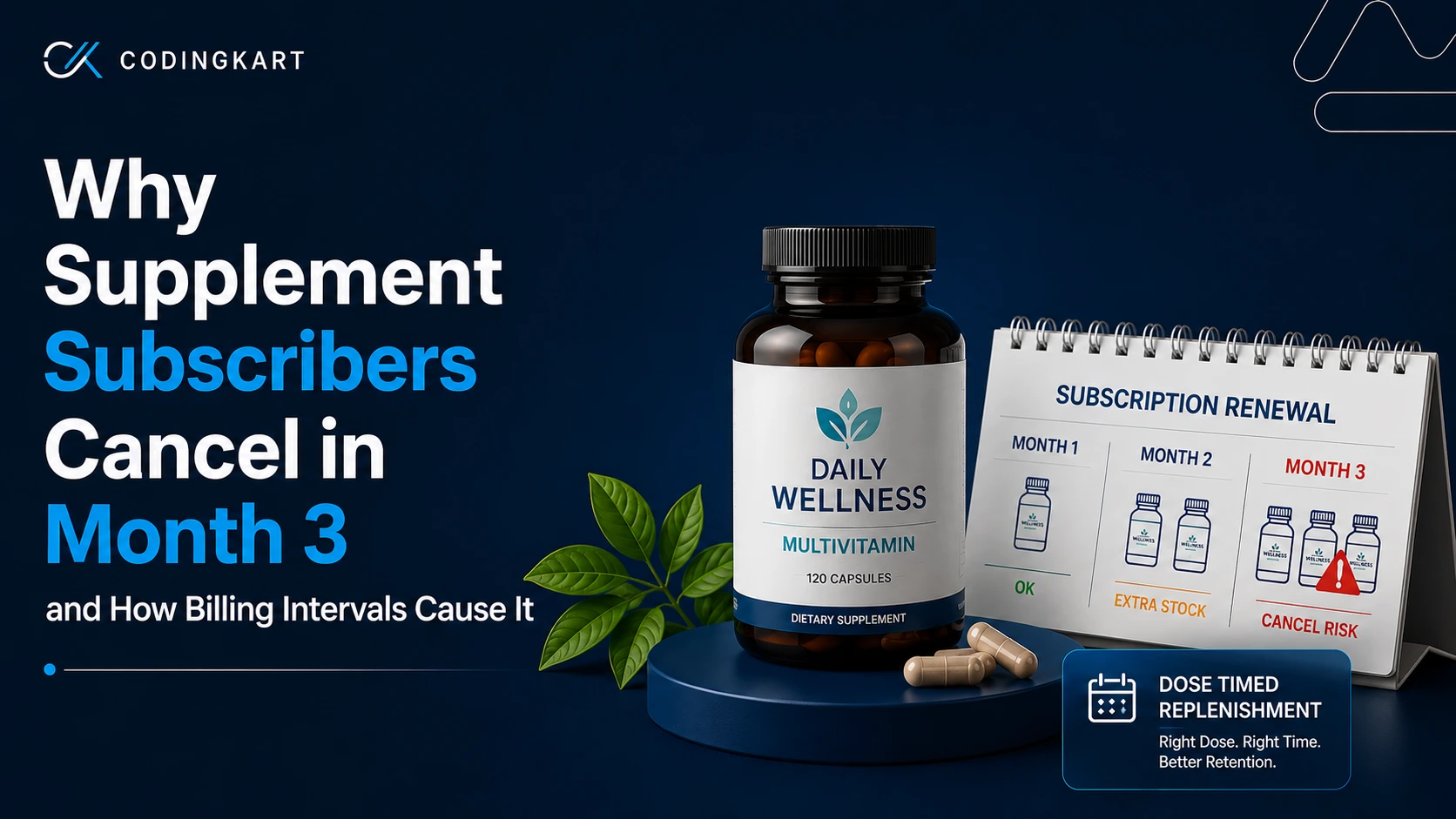
“Please pause my subscription, I still have three unopened bottles.”
That message is not a pause request. It is a cancellation that arrives two weeks early, and it is the single most common way supplement subscription churn on Shopify starts.
Nothing went wrong with your product. Nothing went wrong with your emails either.
What went wrong is that your renewal date and your customer’s actual consumption rate are two completely unrelated numbers. One was set when you configured the selling plan. The other depends on how fast she swallows capsules.
Every retention tactic you layer on top sits downstream of that gap. And unlike a skincare routine, where usage can only ever be estimated, a supplement is countable. Servings per container divided by daily dose gives you an exact number of days, which means this is arithmetic you can fix rather than behaviour you have to guess at.
How Supplement Subscription Churn Disguises Itself as a Pause Request
Almost nobody cancels at the first renewal. They cancel at the second or the third, and by then the cause is three months behind them.
Why supplement subscribers cancel at the second and third renewal
At renewal one, she has a little more than she needs. She notices, shrugs, and puts the spare bottle in the cupboard.
At renewal two, the spare has become a pair. Now it occupies shelf space and it reads as money she did not mean to spend.
At renewal three she cancels, and she does not tell you why. Your exit survey records “too expensive” because that is the closest option to what she feels, which sends you off to build a discount ladder for a problem that was never about price.
Here is the tell. If your support inbox holds more pause requests than product complaints, you do not have a satisfaction problem, you have a timing problem. It is one of several ways recurring revenue quietly disappears in a supplement store without ever showing up as a bad review.
Why a 60 Day Bottle Breaks a 30 Day Billing Interval
Take a 120 count bottle with a label dose of two capsules a day. That bottle lasts 60 days.
How the surplus compounds by day 180
Now put it on a 30 day subscription interval, which is what most brands configure because it matches the monthly billing habit rather than the product.
By day 90, your customer holds roughly one and a half unopened bottles. By day 180 she holds three. She has paid you six times and consumed three bottles, and the gap widens every single cycle without anyone intervening.
The chart below plots that accumulation across 180 days, and the shape of it explains the month three cancellation better than any survey response will.
Four variables no single interval survives
Container size. You sell 30, 60 and 120 count versions of the same product, and they all sit on the same interval because the selling plan was attached at the product level.
Label dose against recorded dose. Your label says one capsule. Your customer takes two, or runs a loading phase, or skips weekends. Whatever number she records is the only one that predicts when she runs out.
Multi buy promotions. Buy two, get one free ships three bottles and extends nothing. The next charge lands on schedule while she sits on 180 days of stock.
Bundle switches. She moves from the 60 count to the 120 count to save money. Her supply duration doubles and her renewal date does not move a single day.
No fixed interval survives all four. The date has to be derived per subscriber and per SKU, or it will be wrong for most of your list most of the time.
Dose Timed Replenishment and How to Set Shopify Renewal Dates by Supply
So what should the renewal date actually be calculated from?
The calculation behind supply days remaining
Servings per unit divided by daily dose gives you supply days. Next charge date equals last fulfilment date plus supply days minus a buffer.
That is the whole of dose timed replenishment. The difficulty was never the formula, it is that Shopify has nowhere to store the two inputs and nothing that recalculates when either one changes.
The fields your subscription contract is missing
You need four values that a standard setup does not carry.
servings_per_unit belongs on the product as a metafield, because it describes the item and never varies by customer. daily_dose belongs on the subscription contract, because it describes the person. supply_days_remaining and next_calculated_date sit on the contract too and get rewritten every time either input moves.
Splitting them that way matters more than it looks. Put dose on the product and every subscriber inherits the same assumption, which puts you back where you started.
Why you ship before zero and not at zero
Ship to land five to seven days before she runs out, not on the day she does.
A subscriber who runs dry for even 48 hours breaks the daily routine, and that routine is the entire retention mechanism for a consumable. Getting her restarted costs you far more than a week of overlap ever will.
What forces a recalculation
Five events change the answer, and the table below sets out what each one moves.
| Event | Recalculates supply | Moves the scheduled order |
|---|---|---|
| Dose change | Yes | Yes, from the next unfulfilled order |
| Bundle or size switch | Yes | Yes |
| Skipped shipment | Yes | Pushes the date, keeps the cadence |
| Manual reorder outside the subscription | Yes | Yes, adds supply and delays |
| Fulfilment or delivery delay | No | Yes, anchors to delivery not billing |
That last row catches people out. Supply starts depleting when the box arrives, not when the card gets charged.
Three Products, Three Depletion Rates, One Box
Your highest value subscriber is also your worst scheduling problem.
She takes three of your products. A daily multivitamin that runs 30 days, a magnesium that runs 90, and a protein tub she finishes in four weeks. Three end dates, and one thing she actually wants, which is a single box.
Shopify will run three separate subscriptions without complaint. She will cancel two of them the first time a lone tub arrives carrying its own shipping charge.
You have three ways out and each one costs you something.
Anchoring to the shortest supply
Bill everything on the fastest depleting item and you get one clean date.
You also ship a 90 day magnesium four times before she opens the second bottle. The surplus you set out to fix comes back at smaller scale, except now it hides inside a bundle and stacks up where she can see it.
Anchoring to the longest supply
Bill on the slowest item and the surplus disappears. So does the protein, six weeks before the next box lands.
A stockout kills the habit that pays for the subscription. This is the worst of the three options and the one brands reach by accident, because the slowest item is usually the most expensive one.
Variable line quantities on a fixed cadence
Ship every 30 days and change what goes inside instead.
Each product carries its own supply days remaining, and the fulfilment logic assembles the box from whatever has run down by the ship date. One tub every cycle, one multivitamin every cycle, one magnesium every third.
She gets a single delivery, a single charge, and no shelf full of capsules she never asked for. The timeline below tracks all three products against one shipment cadence, which is the clearest way to see why the contents have to move.
Building it is harder than describing it. Your inventory forecast, your pick logic and your subscription contract all have to agree on what a shipment contains before that shipment exists.
What this does to order value
Variable boxes mean variable totals, and that is where the approach bites back.
A box worth 84 dollars one month and 39 dollars the next crosses your free shipping threshold in one direction and your volume discount tier in the other. Your recurring revenue reporting stops being a straight line, and finance notices before your developer does.
Settle the rule before anyone writes code. Either you hold shipping and discount benefits at the subscriber level and stop reading per box value, or you accept that some boxes ship at a loss.
We worked through a version of this on a subscription build that had to vary shipment contents without changing what the customer expected to receive.
If you sell more than two SKUs on a shared interval, send us your catalog and we will map where the depletion rates diverge.
What Your Subscription Portal Has to Show the Customer
Calculate all of it correctly and you can still lose the customer at the account page.
The four controls a subscriber needs
Show supply remaining in plain days, not as a progress bar and not as a percentage. Let her adjust her recorded dose and watch the next date update live as she does it. Give her ship sooner and ship later controls that adjust her supply position rather than nudging one order. And state, in one sentence, why the next box is dated what it is dated.
The failure mode that raises support tickets
Custom timing logic behind a stock portal produces dates that look random.
She sees a charge scheduled for the 14th with no explanation, assumes it is an error, and opens a ticket. Portal work is not the polish on this build, it is half of it.
Why Calculated Supply Drifts From Actual Consumption Rate
Your calculated supply will be wrong. Not catastrophically, but consistently.
She travels for a fortnight. She doubles up before a race. Her partner starts taking the magnesium too. None of that reaches your database, and the drift compounds quietly across cycles.
Reading the correction out of behaviour
Behaviour tells you most of what a survey would.
A manual reorder between shipments means she ran short, so shorten her cycle. A pause means surplus, so lengthen it. Adjust silently and never announce that you did.
Asking, and how rarely
One prompt beats a programme. Ask once, at the renewal notification, with a single question about whether the timing feels right.
Monthly check ins train people to ignore you, and an ignored email is worse than no email. Accept that this stays an approximation. Moving from a fixed interval that is wrong for everyone to a derived one that is close for most is the entire win.
Why Shopify Subscription Apps Do Not Support Custom Billing Intervals
Subscription apps model intervals as fixed durations because that is what the underlying billing primitives expose.
Recharge, Appstle, Skio and Shopify native subscriptions all let a customer change their own frequency. That shifts the work onto her and only helps the small share of subscribers who bother to log in and do it.
None of them derive the charge date from catalog data and a recorded dose, and none of them recalculate when either changes. That is not a flaw in the apps, it is a boundary. Single product, single container size, uniform dose, an app handles you comfortably.
Multiple sizes or multi product stacks and you have crossed the line into territory where an off the shelf app stops being the cheaper option. Timing is usually the first place brands notice the ceiling, though it is rarely the only place fixed intervals cost you money.
The Pause Request Was Never About Price
Go back to the customer with three unopened bottles.
She was not unhappy. She was over supplied by a date that had no relationship to how she takes your product, and the cancellation was already scheduled before she wrote to you.
Every subscriber currently on a fixed interval is somewhere on that same curve right now. Some of them are two months from cancelling and none of them will tell you.
Send us your product catalog and your current subscription intervals. We will map where your renewal dates diverge from actual supply, product by product, and tell you what it would take to close the gap with custom subscription logic built on Shopify.
It is the same groundwork we start every supplement and wellness ecommerce build with.
Questions Supplement Brands Ask About Subscription Timing
Why do supplement subscribers cancel after two or three orders
They cancel because surplus stock has become visible. A container that lasts 60 days on a 30 day interval leaves them holding an extra bottle after the first cycle and three extras by month six, at which point cancelling reads as the obvious way to stop the waste.
Can you change a subscription renewal date on Shopify
Yes, individual renewal dates can be edited through the subscription contract, and most apps expose this to the customer as a frequency setting. What is not available out of the box is automatic recalculation, where the date recalculates itself from container size and recorded dose whenever either one changes.
How do you handle multiple supplements depleting at different rates
Keep one shipping cadence and vary the quantities inside the box. Each product tracks its own supply days remaining and the fulfilment logic includes only what has run down by the ship date, which gives the customer a single delivery instead of three overlapping ones.
Does Recharge support custom billing intervals
Recharge supports fixed intervals and customer initiated frequency changes, so a subscriber can move herself from 30 to 60 days. It does not calculate the interval from product data and dose, which is the part that requires custom development on top of the app or a move away from it.

 Get Started
