
Nobody outgrows Recharge in a dramatic way. There is no crash, no outage, no angry all-hands meeting. There is just a Sunday night, a CSV export of tomorrow’s charges, and someone on your team rebuilding the roast plan in a spreadsheet again.
The app never flags a problem. It has no idea your product does not exist until Tuesday morning.
Here is the short version. Recharge handles recurring billing, dunning, payment retries, and charge scheduling well, and none of that is your problem. Your problem is the part of the business that makes you a roaster instead of a warehouse.
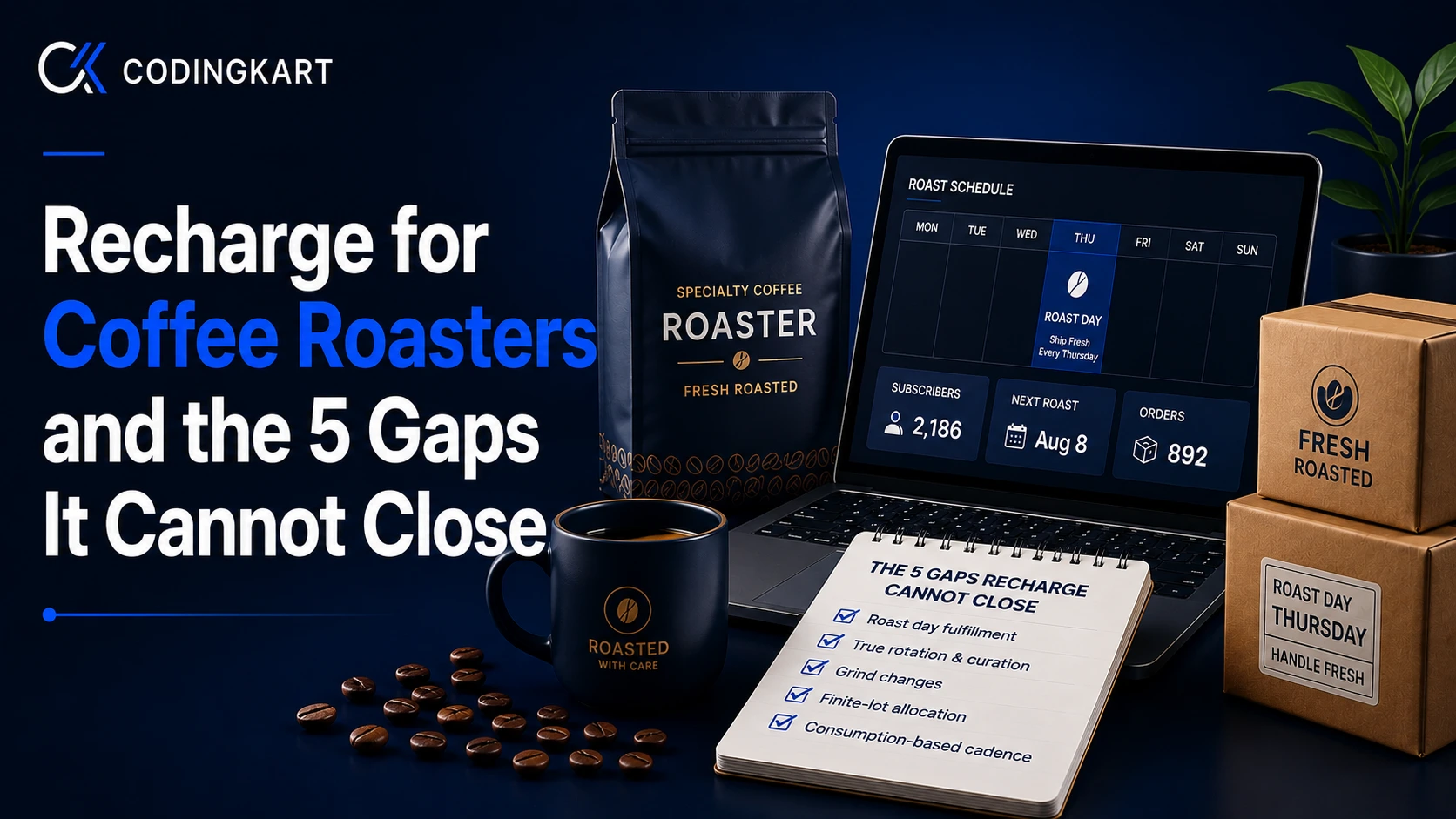
Production-synced fulfillment, subscriber-level curation, grind handling, finite-lot allocation, consumption-based cadence: five kinds of logic no off-the-shelf subscription app can hold. They are not settings you have failed to find. Roasters who hit this boundary usually keep Recharge for billing and build a custom layer on top for everything coffee-specific.
The call between staying on Recharge, layering custom on top, or replacing it is a budget decision in the end, and the numbers work the same for every vertical. The logic gaps do not. Everything below lives on the coffee side: where the boundary sits, how to recognize crossing it, and what gets built across it.
Coffee Doesn’t Fit the Model Subscription Apps Are Built On
Recharge, Appstle, Bold, Skio, Loop, Smartrr. Different logos, one shared assumption: a SKU, a calendar, and a saved card.
Every cycle, the app charges the card, creates the order, and hands it to fulfillment. The model assumes the product sits on a shelf, identical to last month, waiting for a pick.
Supplements fit that model. Skincare fits. Pet food fits.
Roasted coffee breaks it for one structural reason: the product does not exist when the charge fires. You are not shipping from a shelf. You are shipping from a schedule.
The bag a subscriber opens on Thursday was green coffee on Monday. Freshness is an inventory model, not a marketing line. Your sellable stock gets created two or three mornings a week, in batches, with a cupping table in between, and it starts degrading the moment it exists.
So every serious roastery runs two calendars: the billing calendar inside the app and the production calendar on the roastery wall. The app knows nothing about the second one. A person with a spreadsheet fills the gap, and that person is the most expensive middleware in commerce.
At 200 subscribers, the spreadsheet takes an hour a week. At 2,000, it owns every roast-day morning. Somewhere between those numbers, workarounds stop being clever and start being the business.
The Cohort Compromise: Bending the Business to Fit the App
Recharge deserves a fair hearing here, because you will spot a strawman instantly. It can charge every subscriber on a specific day of the week or month, and it supports cut-off windows so a late signup rolls into the next cycle instead of triggering a lonely mid-week order. Both features are real, and both work.
They also form the backbone of the pattern you see across specialty coffee: charge everyone on the 28th, close the window, ship the first Thursday of the month. One cohort, one roast plan, one mail run. Tidy.
Look closer at what that pattern is, though. It is not the subscription you designed. It is the subscription the scheduler can express.
The cut-off clock runs on Eastern Time no matter where your roastery sits. Daylight saving shifts can take a support ticket to sort out, and cut-off rules skip subscriptions you migrated in from a previous platform. Manageable, but brittle.
Rotation flattens to store level. RoasterTools’ own setup guidance steers you toward a single shared schedule where every subscriber receives the same coffee that cycle, and RoasterTools is a Recharge partner. Their reasoning is blunt: a different coffee per subscriber is manual pain the stack cannot automate.
Holds do not exist as a concept. Well-known roasters print it on their product pages: once a subscription order is in motion, nothing can pause it. Not a delayed green shipment, not a batch that failed cupping, not a subscriber emailing about a vacation.
None of this is a bug. It is the edge of the category. The interesting question is what sits past that edge.
Five Kinds of Coffee Logic No Subscription App Ships
Each gap below follows the same shape: what your roastery needs, what the app can express, where it breaks, and what the custom version looks like. Recognize two or more as weekly pain and you are past the boundary. The only remaining question is which path you take across it.
1. Roast-day orchestration: charge → aggregate → roast → QC → release
What you need. Billing that runs ahead of production instead of alongside it. Charges settle Sunday night, and by Monday morning the production plan already knows exactly what Tuesday’s roast must be: which coffees, what batch sizes, which grinds, which bag sizes. Fulfillment fires when the batch clears QC, not when the order gets created.
What the app gives you. A charge day and an order. The order lands in Shopify the moment billing succeeds and instantly looks fulfillable to your 3PL, your shipping software, and your own team. The app holds no concept of a product that will exist tomorrow.
Where it breaks. Planning breaks first. Build the roast plan before charges settle, and failed payments plus last-minute skips create variance. You either over-roast and eat margin on beans that stale, or under-roast and ship someone Thursday’s batch, three days older.
Exceptions break second. When a batch fails cupping or a green delivery slips, no mechanism holds exactly the affected orders, tells those subscribers their coffee is a day late for the best possible reason, and releases everything once the re-roast clears.
What custom looks like. A middleware layer that listens to Recharge’s charge webhooks and pulls the upcoming-charge queue. From there it is systems integration work more than app building: settled demand aggregates into a roast sheet, lands in RoasterTools, Cropster, or your own format, and fulfillment holds sit on the Shopify orders until production marks each batch complete. A failed cupping becomes an event: the hold stays, substitution rules run, and a roasted-fresh-shipping-tomorrow email goes out on its own.
The full loop is easier to see than to read:
[[Diagram 1: the roast-day orchestration loop, from charge webhook to hold release]]
The pattern is not even coffee’s alone. Batch-brewed kombucha subscriptions ship on the same hold-and-release architecture, and so does anything made in small batches and sold fresh.
2. Subscriber-level rotation with memory
What you need. A Roaster’s Choice that behaves like an actual roaster making choices. It remembers this subscriber already received the Ethiopia natural, including the bag they bought one-off in November outside the subscription. It reads their onboarding quiz answers, knows they brew espresso and dislike ultra-light roasts, and assigns each cycle’s coffee accordingly.
What the app gives you. Product swap as a store-level bulk action. You can change what the rotating product is this month. Everyone gets it.
Where it breaks. Store-level rotation has no memory and no preferences. Your most engaged subscribers, the ones who also buy releases as one-offs, are exactly the people most likely to open a box and find a coffee they finished last week.
So the customers most worth keeping get the worst version of the experience. The support inbox fills with the politest churn warnings ever written: love you guys, but I just had this one.
One picture makes the gap obvious:
[[Diagram 2: store-level rotation vs subscriber-level rotation, side by side]]
What custom looks like. A rotation engine. Each subscriber carries a preference profile built from quiz answers, full purchase history, and explicit exclusions, with no repeats inside a rolling window. An assignment pass runs each cycle, distributes the current menu across the base under your rules, and writes every assignment onto the upcoming order through the API before the charge fires.
Production still receives clean totals: 412 bags of the Colombia washed, 218 of the Guatemala honey. To the subscriber it feels like a human curator. At 3,000 subscribers, this engine is the only way a human curator can exist.
3. Grind as a preference, not a variant
What you need. Grind as a setting on the subscriber. Whole bean to Aeropress in ten seconds from the portal, flowing straight onto the grind station’s production sheet.
What the app gives you. Grind as a variant. Eight grind options across three bag sizes means 24 variants per coffee before roast level enters the math, and a menu of 15 to 20 coffees leaves you maintaining hundreds of variants, each needing its own selling-plan wiring.
When a subscriber wants a different grind, the portal offers a product swap. That swap creates a new line item, which can detach the discount, reset product-level history, and pollute every report built on the assumption that swaps mean taste changes.
Where it breaks. In the support queue and the analytics, at the same time. Grind changes turn into tickets, and “just reply to this email and we will sort it” becomes the sentence that admits your portal has failed.
Meanwhile your dashboards stop distinguishing a taste-driven swap from a grind correction. For a roaster, that is not cosmetic. Coffee-level retention is the signal your green buying should be reading.
What custom looks like. One variant per coffee and size, with grind stored as a line-item attribute on the subscription contract. Subscribers edit it in a custom portal without touching the product, and it prints onto pick lists and the grind-station sheet automatically. The catalog shrinks by an order of magnitude, and swap data becomes trustworthy again.
Pet brands hit the same wall with weight-based pricing, meal kits with delivery windows. The moment real options outgrow the portal, a custom layer over Recharge stops being a luxury and becomes the fix.
4. Micro-lot allocation and subscriber-first drops
What you need. Sixty bags of a Gesha exist. Twelve-month subscribers get first access for 48 hours, six-month subscribers follow, then the public. A curated tier that promises rare lots pulls from a reserved pool automatically.
What the app gives you. Infinite inventory, conceptually. Subscription products carry no notion of a finite lot, a reserved allocation, or a tenure-gated window.
Where it breaks. Roasters resolve the mismatch in the worst direction: limited releases move outside the subscription entirely, sold as one-off drops, because only that flow respects scarcity. Access is the strongest retention asset a specialty roaster owns, and this setup locks it out of the one product built to drive retention. Your subscribers watch the interesting coffee sell out on Instagram like everyone else.
What custom looks like. An allocation engine between inventory and the subscriber base. Lots split into pools, subscription-reserved and public, with access tiers keyed to tenure and timed release windows. Curated tiers draw from their reserve automatically.
Wine clubs solved this decades ago through tiered member allocation; coffee micro-lots are the same problem with a shorter shelf life.
5. Consumption-cadence intelligence
What you need. Cadence that tracks how people actually drink. A 12oz bag holds roughly 20 to 25 cups, so a two-cup-a-day household empties it in about twelve days. Put that household on the default every-four-weeks plan and they buy supermarket coffee in the gap.
The reverse case hurts more. The two-bag subscriber who slowed down over summer now stares at three unopened bags, and the sequence begins: stockpile, skip, pause for now, gone.
What the app gives you. A frequency dropdown, chosen once at checkout by someone who has no idea what their real burn rate is. Most never touch it again.
Where it breaks. Silently, inside the frequency histogram. Pull yours: if 70 to 80 percent of subscribers sit on the default cadence, you are not looking at a preference, you are looking at an unread setting. That one setting quietly feeds both your out-of-coffee churn and your too-much-coffee churn.
The app records the skips. It never asks why, and it never proposes the fix.
What custom looks like. A consumption model per subscriber: bag size, household signals from the quiz, skip and pause behavior as drift indicators. The model drives proactive nudges, like an offer to move from four weeks to three, accepted in one tap and written to the contract through the API.
Supplement brands run the identical play as dose-timed replenishment, and it works for the same reason: the mismatch gets repaired before the subscriber ever feels it.
Seven Signs You Have Crossed the Boundary
Skip the consultant. Your operation already answers this question, in seven tells:
- A ritual export exists. Someone downloads upcoming orders into a spreadsheet before every roast day, and the roast plan lives there instead of in a system.
- Support is the real portal. Grind changes, coffee preferences, and hold-my-box requests all resolve by email, with a human editing subscriptions by hand.
- Rotation complaints come from your best customers. The already-had-this-one emails cluster among long-tenure subscribers who also buy one-offs. Store-level rotation guarantees it.
- Drops happen outside the subscription. Your rarest coffees stay structurally invisible to your most committed customers.
- The frequency histogram is a spike. Most subscribers sit on the default cadence while skips keep climbing.
- You keep saying “technically.” You can technically change your grind, just email us. Every technically is a workaround in a trench coat.
- Roast variance shows up in margin. Over-roasting covers failed payments, under-roasting punishes late signups, and Tuesday bags taste fresher than Thursday bags.
Two or more of these, felt weekly, means the spreadsheet person is your subscription platform. The app is just its billing module.
Driftaway sat at five of the seven when we first opened their dashboard together. [[One-line rebuild result with metric, linked to the Driftaway case study]]
What Going Custom Actually Means (and What It Doesn’t)
Start with what it does not mean: ripping out Recharge on principle. Stay, layer, or replace is a budget question, and the budget math works the same whether you roast coffee or bottle serums. The coffee question is what the layer has to contain.
For most roasters the answer is the hybrid. Recharge keeps doing what it does well, meaning cards, retries, dunning, taxes, and the compliance surface nobody should rebuild for fun. A custom layer on its API and webhooks owns the five kinds of logic above.
In practice that layer ships as a private Shopify app your store owns. Inside it live the orchestration middleware, the rotation engine, grind-as-preference with the portal that exposes it, the allocation pools, and the cadence model. Production tools like RoasterTools or Cropster plug into the layer, not into the subscription app.
Ownership is the quiet bonus. Once the logic lives in code you control, moving your subscriber base to another engine later becomes a project instead of a rewrite, because the layer travels with you.
And if you are still comparing engines rather than layers, compare with clear eyes. Every serious Recharge replacement carries the same category ceiling, so a switch buys better pricing or portal polish, never roast-day logic.
What Should Stay on the App
Why not rebuild everything, then?
Because custom fails when it gets ambitious in the wrong direction. Payment vaulting, retry logic, dunning flows, PCI scope, tax handling, and the basic skip-pause-cancel actions are solved problems with a decade of edge cases baked in. Rebuilding them buys risk, not differentiation.
The craft sits in drawing the line precisely. Everything generic stays on the platform. Everything that smells like coffee moves into the layer you own.
Roasters who draw it well end up with a subscription their app’s competitors demo in sales calls, running on the same app everyone else already has.
FAQ
Can Recharge charge subscribers around our roast schedule?
Partly. Recharge supports charging on a specific day of the week or month, with cut-off windows for late signups, which is enough to run a single-cohort model. It cannot connect billing to production: no holding fulfillment for a roast batch, no QC gate, no automatic release when coffee comes off the drum. That connection is middleware you build.
Does Recharge support a true roaster’s-choice rotation?
At store level, yes: you change what the rotating product is, and every subscriber receives that same coffee for the cycle. Subscriber-level rotation with memory, meaning no repeats and preferences respected, is not native to Recharge or its peers. It takes a custom assignment engine built on the subscription API.
Would switching to Skio, Smartrr, Appstle, Bold, or Loop fix these gaps?
No. These are category boundaries, not vendor ones. Anchor billing and cut-off windows exist across most of the category, while production-synced fulfillment, per-subscriber curation, finite-lot allocation, and consumption modeling exist nowhere off the shelf. Switching apps can improve pricing or portal polish, but it relocates the boundary instead of removing it.
Do we have to leave Recharge to get this logic?
Usually not. The most common architecture keeps Recharge on billing while a custom layer on its API and webhooks handles the coffee-specific logic: orchestration, rotation, grind, allocation, and cadence. Full replacement on Shopify’s native subscription APIs is a further step about ownership and scale, not a prerequisite.
When does custom development make sense for a roaster?
When the operational signals stack up: a standing spreadsheet ritual around roast days, support handling what a portal should, rotation complaints from long-tenure subscribers, limited lots sold outside the subscription, or a frequency histogram frozen on the default. Signal count matters more than subscriber count. The budget thresholds sit in our Recharge decision framework.

 Get Started
