
If your shortlist has Skio on it, throw the shortlist away.
On 30 April 2026, Recharge acquired Skio for $105 million in cash. Skio was doing roughly $32M in annual recurring revenue at the time. Both companies confirmed it, Skio included. The combined business now claims more than 20,000 merchants and over $20 billion in annual GMV.
Most articles ranking for Recharge alternatives today still list Skio as the scrappy independent challenger. They were written before the news and nobody went back to update them.
That matters beyond one company, because it tells you what these comparisons are worth. A shortlist assembled from blog posts is a snapshot of a market that has already moved, and this market moved twice in the first half of 2026.
So the useful version of this comparison is not a ranking. It is a way of working out which constraint you are actually up against, which survives the next acquisition and the next pricing change.
Worth being precise about what you are actually replacing. A Recharge alternative has to do four separate jobs: run the billing engine, host the customer portal, integrate with checkout, and provide retention tooling. Most brands evaluate the fourth, sign up because of the third, and then discover the first two are where the cost lives.
What actually changed in 2026
Recharge has said that nothing changes today for merchants on either platform, and that a combined roadmap is coming in the months ahead. Both statements are true. Neither tells you what your platform looks like in eighteen months.
Read the acquisition without drama. Two products with heavily overlapping functions now sit under one owner. That situation historically resolves toward convergence, and convergence means somebody’s product roadmap becomes somebody else’s priority list.
If you are on Skio today, nothing is on fire. What has changed is that you no longer control the roadmap you bought into, and it is reasonable to start understanding your exit options while there is no pressure to use them.
There is a second change that gets less attention and costs more money.
Recharge’s transaction rate moved during 2026. As of today, their pricing page lists $99 a month plus 1.49% and 19 cents per transaction on the entry paid plan. A large share of published comparisons still quote 1.25%, which was the earlier rate, and some quote figures that match nothing on the live page at all.
A quarter of a percent sounds like rounding. On $2M of annual subscription GMV it is $4,800, which is more than most brands spend evaluating the decision in the first place.
Check the vendor’s own pricing page before committing to anything, including the figures below. Every number here was verified on 10 August 2026, and this category rewrites pricing faster than anyone updates their writing about it.
The four questions that actually decide this
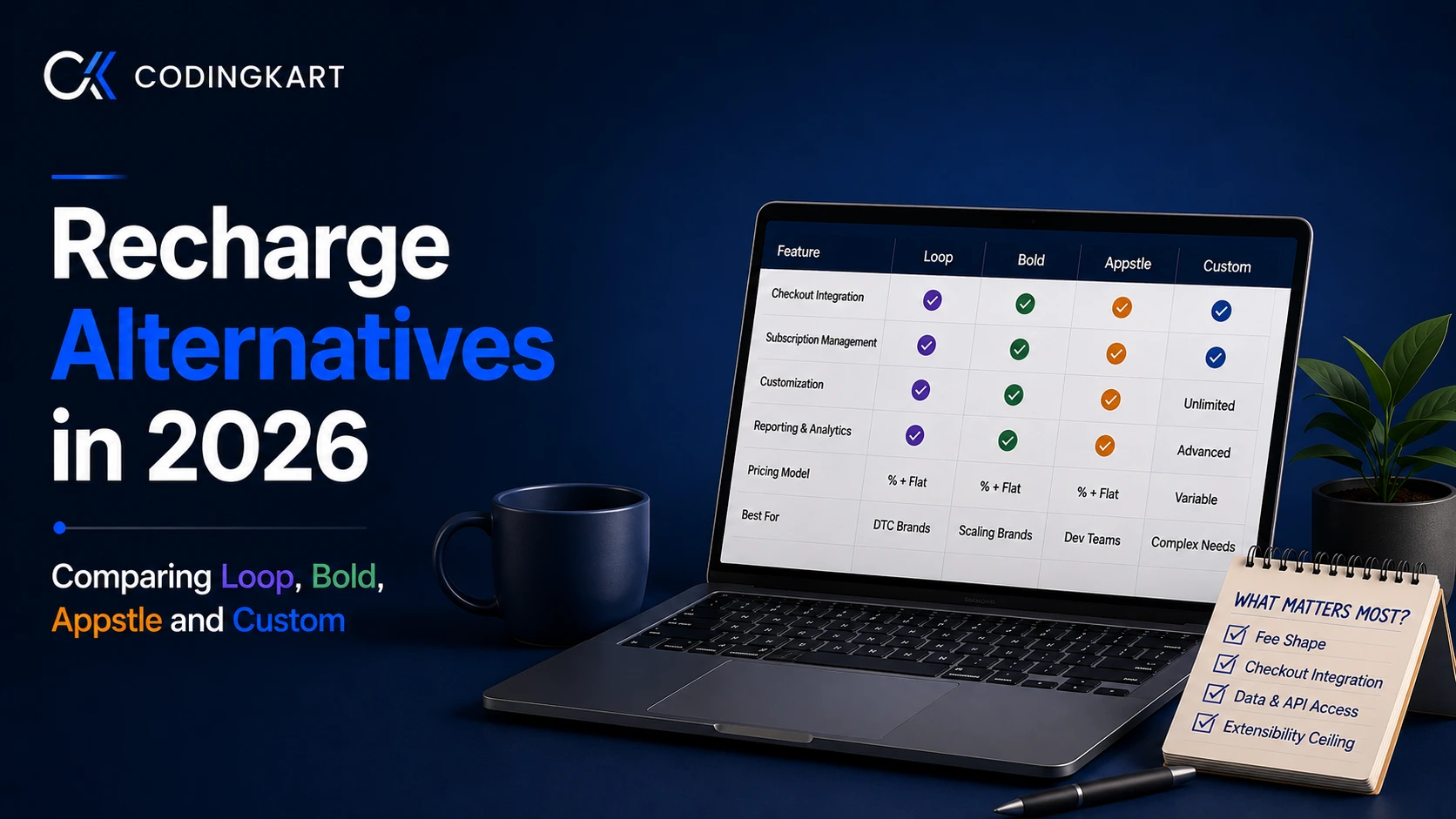
Feature tables are how you lose three weeks. Every Shopify subscription app in this category does the obvious things well, and the differences that decide your outcome do not appear in a checklist.
Four questions decide the outcome.
Fee shape, not fee size. A percentage of GMV and a flat monthly fee are different shapes of cost, and the crossover between them moves as you grow. A rate that reads as trivial at $10K MRR becomes one of the largest fixed lines on your P&L at $200K. Model your real volume and then model it again at three times your current size.
Checkout integration. Whether the platform uses native Shopify Checkout decides whether Shop Pay one-tap works on the transaction that creates the subscription contract. That is a conversion variable on your highest-intent moment, and it dwarfs most of the feature differences people spend weeks comparing.
Data and API depth. What can you read, what can you write, what events can you react to, and what happens to all of it if you leave. Migration difficulty gets decided the day you pick a platform, not the day you try to escape one.
The extensibility ceiling. Every platform has a point where support replies that something is not supported. You will reach it. The only question is whether that happens in year two or year seven.
| Question | Why it decides the outcome | How to test before committing |
|---|---|---|
| Fee shape | Cost curve differs by growth stage | Model current volume and 3x volume |
| Checkout integration | Shop Pay on the contract-creating order | Ask for a live store running native checkout |
| Data and API depth | Determines future migration cost | Request the API docs and read the write endpoints |
| Extensibility ceiling | Decides when you outgrow it | Send your three hardest requirements to support |
That last test costs nothing and tells you more than any demo. Write down the three most awkward things your subscription has to do, send them to each vendor’s support team, and compare the answers rather than the marketing pages.
Where each one actually stops
Every platform here is competent. The useful question is where each one runs out of room, and for whom that happens soonest.
Loop is built on Shopify’s native subscription APIs and has positioned itself hard at merchants leaving Recharge. Retention tooling is its strongest area, particularly the cancel-flow builder, and its published pricing carries no per-order flat fee. It is a strong default for growth-stage DTC brands that are margin-conscious and want native checkout behaviour without an enterprise contract.
Where it stops is depth of unusual logic. If your subscription is a straightforward recurring product with retention layered on top, Loop handles it well. If your product needs the platform to reason about things that are not products, you will be building on top of it sooner than you expect.
Bold Subscriptions has the longest track record in this category and prices simply. No per-order flat fee, all features included on each tier, and an entry price well under Recharge’s. For an early or mid-stage store that wants predictable costs and a guided migration, it does the job without drama.
Where it stops is extensibility. Platform age shows in the API surface, and teams needing to build significant custom logic on top find fewer places to attach it.
One caution that applies to every platform on this list. A limitation you read about in a comparison is a limitation as of the day someone wrote it. All four vendors ship continuously, and the wall you were warned about eighteen months ago may have moved. Verify the specific constraint that matters to you rather than trusting anyone’s summary, again including this one.
Appstle has an enormous install base and the most aggressive pricing in the comparison, with zero transaction fees on paid plans and tiers that start in the low tens of dollars. For a store under moderate volume, the annual difference against a percentage-fee platform runs into thousands of dollars for a comparable core feature set. That is not a small consideration and anyone dismissing Appstle on price alone has the argument backwards.
Where it stops is support depth and custom logic at scale. The pricing model that makes it attractive at $20K MRR is built on serving a very large number of merchants efficiently, and complex requirements get less bespoke attention than they would elsewhere.
Shopify native Subscriptions is free, improving steadily, and genuinely sufficient for a brand testing whether recurring revenue works at all. Starting here and outgrowing it is a much better outcome than paying for a platform you never needed.
Where it stops is retention tooling and portal depth. Dunning, cancel flows, and subscriber self-service are where most brands discover the free option was free for a reason.
| Platform | Fee shape | Best fit | Where it stops |
|---|---|---|---|
| Recharge | Monthly + % + per-order | Enterprise depth, widest ecosystem | Cost at scale, percentage on all GMV |
| Loop | Monthly, no per-order fee | Growth-stage, retention-led | Unusual product logic |
| Bold | Lower monthly + % | Cost-predictable mid-market | API surface and extensibility |
| Appstle | Low monthly, 0% on paid plans | Cost-sensitive, standard requirements | Bespoke support and complex logic |
| Shopify native | Free | Testing subscriptions at all | Retention and portal depth |
What a migration actually costs
Switching platforms looks like a pricing decision until you scope it. Then it becomes an operations project with a risk profile.
Payment tokens are the whole problem. Whether stored payment methods transfer depends on your gateway and both platforms, and when they do not, you are asking every subscriber to re-enter a card. That request is the single largest source of churn in a badly run migration, and it is entirely avoidable if you establish the answer before you sign anything.
Billing dates are the second trap. A migration that resets every subscriber to the same renewal date creates a fulfilment spike your 3PL has not planned for, and it usually surfaces in week three when the first consolidated batch hits.
Custom logic does not migrate. Anything your team built against the old platform’s API gets rebuilt against the new one. This is routinely the largest line in the budget and the one nobody scopes at the start, because it does not appear on either vendor’s comparison page.
Historical order data is the quiet one. If it does not come across cleanly, your cohort reporting restarts from zero and every retention metric you track becomes uncomparable to last year.
None of this makes migration a bad idea. Brands migrate off Recharge successfully every week, and plenty are better off afterwards.
It makes it a project with a real number attached, and that number belongs in your comparison alongside the monthly fee. A platform that saves you $900 a month is not a saving if reaching it costs $40,000 and two months of engineering attention you needed elsewhere.
Run the payback period the same way you would on any other capital decision.
When custom is the wrong answer
We build custom subscription systems. We also talk more brands out of them than into them, and this section is the honest version of why.
If your requirements fit inside a settings panel, an app is cheaper than anything you could build. Not slightly cheaper. Cheaper by an order of magnitude, because the app amortises its development across thousands of merchants and you would be paying for all of it alone.
Custom also means owning the unglamorous parts forever. Dunning logic. Retry schedules. Payment token storage and the PCI scope that comes with it. Gateway edge cases at two in the morning. Every one of those is solved, tested, and maintained inside the platforms you are considering, and none of it is where your competitive advantage lives.
A build is not a purchase. It is a commitment to a codebase, and that codebase needs attention every year it runs. Budget for the second year and the third, because the platforms you are comparing are funding their own maintenance out of the fee you objected to.
There is a subtler version of the same mistake. Some brands commission custom Shopify subscription development to escape a percentage fee, then discover the fee was buying dunning quality they never measured. Involuntary churn is invisible until it is yours to manage, and recovering a failed payment well is worth more than most feature requests.
The threshold is genuinely high. Most brands never cross it, including brands well into seven figures of subscription revenue. If your honest answer to “what can the app not do” is a list of inconveniences rather than a structural impossibility, buy the app and put the money into acquisition.
We covered the full version of this argument in our comparison of Recharge against custom development.
When custom is the right answer
Three conditions, and they have to hold together rather than individually.
The first is arithmetic. Percentage fees on GMV scale with your revenue while a build’s cost amortises against it. At sufficient volume the lines cross, and past that point you are paying a growing tax for a fixed capability. Work out where your crossover sits before assuming it is far away.
The second is structural. Not a missing setting, but logic the platform’s data model cannot express. A subscription that is a set of items with internal rules. A rotation engine constrained by a production calendar. A membership where entitlement is calculated before inventory is consulted. Those are the shapes we get called about, and they share a property: no settings panel fixes them, because the platform models a product and the brand sells something else.
The third is systemic. Subscription is one component of a larger system, and the customer record has to be shared across catalogue, fulfilment, and something operational the platform has never heard of.
One condition is a feature request. Two is a workaround. Three is a build.
The pattern worth noticing is that none of the three is about size. We have seen brands at $30K MRR that genuinely needed a custom system because their product had rules no platform could hold, and brands at ten times that running comfortably on an off-the-shelf app because their subscription was a box of things on a schedule.
Complexity of logic decides this, not volume of revenue.
How to decide this week
Skip the demos for a moment and run four things.
Calculate your true annual platform cost at current volume, then at three times current volume. Include the percentage, the per-order fee, and the plan tier you will be forced onto at that size.
Count your workarounds. Every spreadsheet, every support macro, every manual monthly export that exists because the platform will not do something. That list is your real feature gap and it is more accurate than any comparison table.
Write down the three hardest things your subscription has to do, and send them to the support teams of every platform on your list. Compare the answers.
Then check what your team built on top of your current platform, because that is what you rebuild if you move. Ask whoever wrote it, not whoever manages it.
Those four answers will decide this faster than any demo, and they cost you an afternoon rather than a quarter.
Most people reading this should switch apps rather than build one. That is the honest recommendation and it holds for the clear majority of brands on Recharge today, including some who arrived here hoping to hear otherwise.
The rest of you already know which of the three conditions you meet. You have known for about six months, and the workaround list on your desk has been getting longer the whole time.
Frequently Asked Questions
Is Skio still an alternative to Recharge?
No. Recharge acquired Skio on 30 April 2026 for $105 million. Both platforms continue operating and Recharge has stated a combined roadmap is coming, but Skio is now a Recharge product rather than a competing option.
What is the cheapest Recharge alternative?
Appstle and Bold generally price lowest, and Appstle charges no transaction fees on paid plans. Shopify’s native Subscriptions app is free. Verify current pricing on each vendor’s own page, since rates in this category change several times a year.
Can you migrate off Recharge without losing subscribers?
Usually yes, provided payment tokens transfer between platforms and gateways. Confirm that before signing anything. When tokens cannot move, subscribers must re-enter card details, which is where most migration churn happens.
Does Recharge charge transaction fees?
Yes. As of 10 August 2026 their pricing page lists $99 monthly plus 1.49% and 19 cents per transaction on the entry paid plan, with a lower percentage on higher tiers. The rate increased during 2026, so older comparisons quote outdated figures.
When is custom subscription development worth it?
When three conditions hold together: percentage fees exceed a build’s amortised cost at your volume, your logic is structurally inexpressible in any platform’s data model, and subscription shares a customer record with a wider system. One or two conditions is not enough.
Do Recharge alternatives work with Shopify Checkout?
Most current platforms integrate with native Shopify Checkout via Checkout Extensibility. Confirm it per vendor, because native checkout determines whether Shop Pay one-tap works on the order that creates the subscription contract.

 Get Started
