
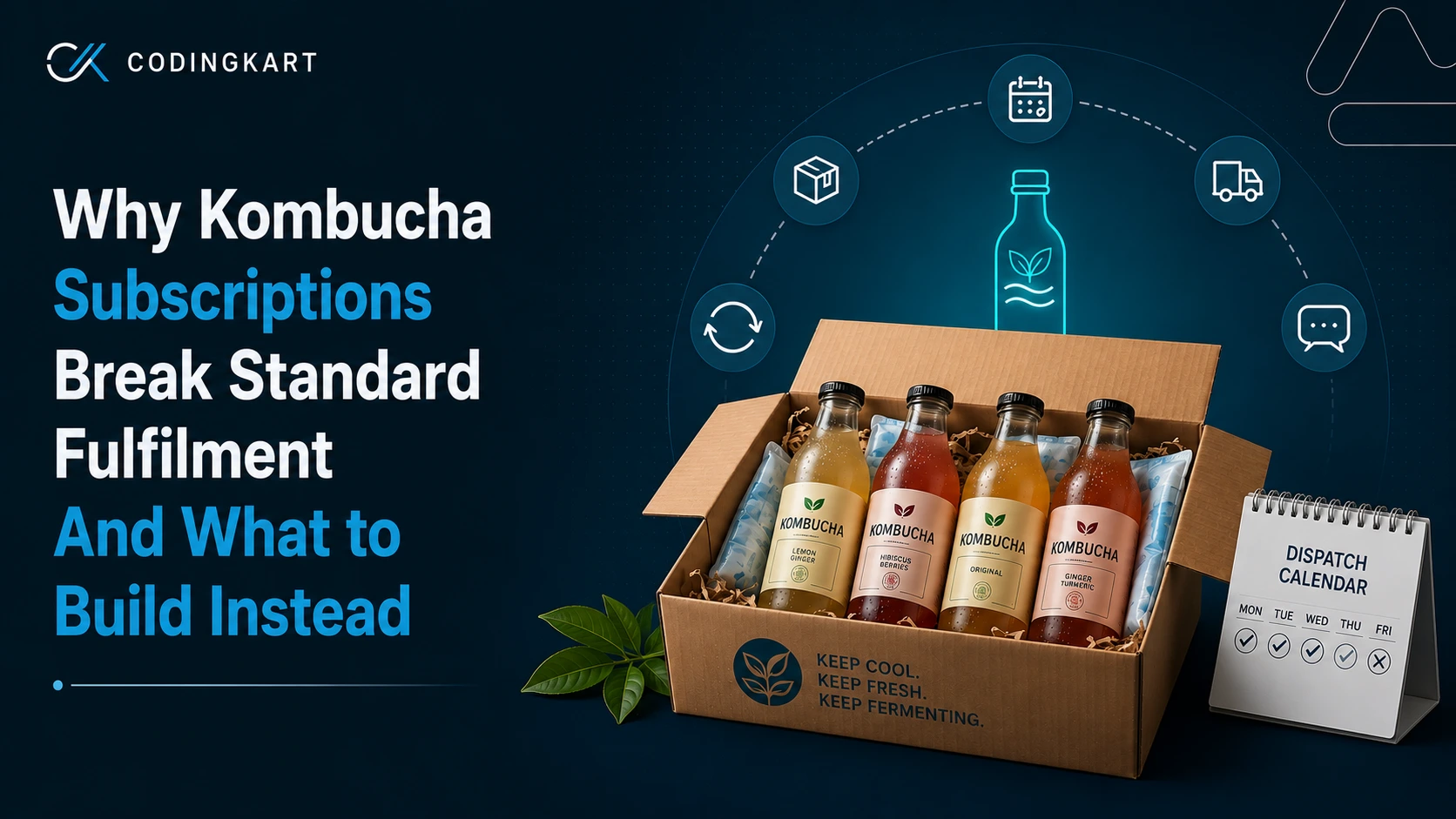
Two subscribers on the same plan. Same batch, same dispatch date, same SKU.
One lives in Newark and receives her bottles eighteen hours later. The other lives in Phoenix, and his order spends four days in transit, two of them in a trailer sitting above 80°F. She opens a crisp, lightly effervescent kombucha. He opens something that hisses at the cap, foams over the counter, and tastes noticeably more sour than the last one he got.
Nothing in the subscription platform recorded a difference between those two orders. Both were fulfilled correctly. Both show as delivered. Neither triggered an exception.
That’s the problem. If you run subscriptions for kombucha, cold-pressed juice, raw pet food, or anything else that’s still biologically active when it leaves your warehouse, this is the failure mode you’re up against — and it isn’t a shipping problem. This article covers why standard Shopify subscription fulfillment breaks for perishable products, what your subscription app structurally cannot see, and the architecture that actually solves it.
The Friday Dispatch That Arrives as a Different Product
Most perishable subscription businesses discover this the same way: not through a warehouse failure, but through a slow accumulation of support tickets that don’t share an obvious cause.
A customer says this month’s delivery tasted different. Another says a bottle leaked in the box. A third asks why her order sat in a depot over the weekend when she paid for two-day shipping. Individually, each ticket gets closed. Collectively, they’re describing one thing: the product that arrived is not the product you packed.
Here’s the distinction that matters. Most perishable goods degrade — they get older, staler, closer to a date. Kombucha does something different. It’s alive, and it keeps working. Fermentation doesn’t pause for logistics. Yeast keeps converting sugar, CO2 keeps building, and internal pressure keeps climbing — faster when it’s warm, slower when it’s cold, and entirely dependent on how long the bottle spends between your dock and the customer’s fridge. A batch that’s perfect on day three can be over-carbonated by day nine.
So dispatch timing stops being an operations metric and becomes a product specification. A Friday afternoon handoff to a carrier means a package sitting in a hub through Saturday and Sunday. Whether that matters depends on the batch’s age, the destination zone, and the season — three variables that live in three different systems, none of which talk to each other.
This is where most brands start optimizing the wrong layer. They negotiate better carrier rates. They switch 3PLs. They add insulated liners. Those changes help at the margins, but they treat the symptom. The reason the same subscription produces inconsistent products is that nothing in the stack is modeling the product as something that changes.
Your billing platform knows who gets charged and when. Your inventory system knows how many units exist. Your carrier knows where the box is. Not one of them knows how old the batch is, how warm it got, or whether this particular bottle should have gone to Phoenix at all.
What Subscription Apps Cannot See
Recharge, Appstle, Skio, Loop, and Stay Ai are good at what they were built for. They handle billing cycles, dunning, subscriber portals, pause and skip flows, and retention offers — and they handle them well enough that most brands run on them for years. This is not a criticism of those tools.
But every one of them models the same three variables:
Who is subscribed. What they receive. How often it ships.
That’s a complete data model for a product that doesn’t change. For a perishable product, it’s missing everything that determines quality:
- Batch production date and how much live window remains
- Transit temperature exposure across the route
- Zone dwell time — how long a package sits before final-mile handoff
- Packaging format constraints by destination, because glass and cans have different risk profiles
- Actual consumption rate — whether the subscriber still has four unopened bottles
None of these are exotic. They’re the variables a production manager uses every day. They just have nowhere to live in a subscription app’s schema, because the app was designed around a recurring charge, not a perishable good.
The result is a system making decisions it doesn’t have the data to make. When a renewal fires on the first of the month, the platform selects inventory by availability, not by batch age. It applies a shipping rate by weight and zone, not by how many days of live window the product has left. It dispatches on the next business day, not on the day that produces the best arrival.
Every one of those is a defensible default. Together, on a product that’s still fermenting, they produce the Newark-and-Phoenix problem.
Worth knowing: Shopify itself acknowledges part of this gap. Its automated delivery date estimates — the ones that show customers an expected arrival window — explicitly exclude subscription orders, alongside digital products, app-provided pre-orders, and try-before-you-buy. Every subscriber to your perishable product is invisible to Shopify’s own delivery expectation system. If freshness depends on arrival timing, the platform’s native answer is that it won’t predict arrival timing for these orders at all.
Shipping Isn’t the Problem — It’s Where the Problem Surfaces
When a subscription box arrives flat, over-carbonated, or leaking, shipping takes the blame. Sometimes that’s fair. More often, shipping is just the last step in a chain, and the point where every earlier decision becomes visible at once.
Consider what’s already been decided before a carrier ever scans the label.
Production determined how much live window this batch has. Inventory allocation determined which batch fills this order. The subscription schedule determined that this order exists today rather than four days from now. Checkout determined that this customer could receive glass in the first place. Customer communication determined whether a Monday dispatch reads as thoughtful or as a delay.
By the time the parcel is in a van, the outcome is largely locked in.
This is why faster shipping so rarely fixes recurring freshness complaints. A next-day carrier can’t recover a batch that was already eleven days old when it was picked. A better rate card can’t fix a renewal date that ignores your production cycle. And no amount of transit speed helps if the customer never understood why their order deliberately waited until Monday.
Shipping is a diagnostic surface. It shows you the aggregate result of production, inventory, subscription timing, and expectation-setting working together — or failing to.
Which means the fix isn’t in the shipping layer. It’s in whether those four systems can see each other at all.
The Four Systems Behind Perishable Subscription Fulfillment
| System | Standard question | Perishable product question |
|---|---|---|
| Dispatch | How fast can this ship? | What arrival date does this batch need? |
| Inventory | How many units? | How much live window remains? |
| Renewals | When is the next charge? | Has the last order been consumed? |
| Eligibility | Can we ship here? | Can we ship this format here, this week? |
Dispatch Timing and Transit Modeling
The useful unit isn’t ship date, it’s arrival date under expected conditions. That means dispatch decisions need transit-time data by zone and a rule set that can hold an order rather than release it.
A Shopify dispatch day restriction built properly doesn’t just block Friday globally. It evaluates destination zone, expected transit duration, batch age, and seasonal temperature, then either releases the fulfillment order or holds it until the next viable window. A short-haul Northeast order might ship Friday safely. The same batch going to Arizona in August shouldn’t.
Batch Age and Freshness Inventory
Neither Shopify nor WooCommerce has native first-expired-first-out logic. Inventory is a count, not a timeline. For a perishable product you need every unit associated with a production date and a computed remaining window, and you need allocation to select against that — reserving the oldest still-viable stock for the shortest routes, and the freshest for the longest.
This is the layer most brands skip, and it’s the one that quietly causes the most variance.
Renewal Logic That Respects Consumption
A renewal that fires while the customer still has four unopened bottles doesn’t just create a cash-flow annoyance. It creates aging inventory in someone’s kitchen and a product experience you no longer control. Renewal timing should be able to respond to consumption signals — order size, previous skips, portal activity, seasonal patterns — rather than running a fixed 30-day loop regardless.
Eligibility Validation at Checkout and Renewal
This is the one almost everyone misses.
Most stores validate delivery eligibility once, at signup. But a subscriber’s circumstances change. She moves. Her region gets added to a heat advisory. You discontinue glass to her zone. The subscription keeps renewing against a rule that was evaluated eighteen months ago and never re-checked.
This is the same architectural failure covered in our WooCommerce wine and spirits compliance post, where age and jurisdiction are verified at signup and never again. Different domain, identical flaw: validation that runs once on a relationship that runs forever.
Eligibility has to be re-evaluated on every renewal, not just the first order.
How to Actually Build This
Here’s what the implementation looks like across both platforms. Some of this is native, some needs building, and the honest answer on several points is that it depends on your plan tier.
Selling plan groups and delivery profiles
Shopify’s subscription primitives are selling plan groups — they define billing frequency and delivery policy, and they’re what any subscription app is manipulating underneath its UI. Delivery profiles let you assign different shipping rates and zones per product, which is the native foundation for treating glass and cans differently.
Useful and underused: fulfillments on a subscription order can be split within a single order based on a product’s fulfillment location or shipping profile. That’s the native hook for routing formats down different paths without splitting the customer’s order into two purchases.
Where it stops: selling plans can express every 30 days. They cannot express every 30 days, unless the batch is older than 12 days, in which case hold.
Batch and expiry architecture
Three viable approaches, in ascending order of cost and control:
- Metafields on inventory or product variants carrying production date and computed expiry. Cheap, fast, adequate for single-location brands with straightforward SKUs. Fragile once you’re multi-location.
- Location-based separation, where batches map to distinct fulfillment locations and allocation logic routes by location. Uses native primitives, no external system, but gets awkward past a handful of live batches.
- External WMS or ERP as the source of truth, with the storefront querying it at allocation time. Correct at scale, meaningfully more expensive, and only worth it when batch volume justifies it.
There’s a related trap in prepaid plans. Inventory for a prepaid subscription cycle is reserved when the fulfillment date is reached — not when the customer pays. A brand selling three-month prepaid boxes has revenue booked against inventory it has no commitment on. For a product with a production lead time and a shelf life, that’s a planning gap worth closing deliberately.
One more constraint to design around: if an order contains a prepaid selling plan, you cannot duplicate it or edit line item quantities. A batch swap for freshness can’t be done by editing the order. It has to happen at allocation, before fulfillment.
Dispatch-day rules
| Approach | Good for | Limitation |
|---|---|---|
| Shopify Flow | Tag-based holds, simple day blocking | Struggles with multi-variable conditions |
| Carrier Service API | Real-time rates and options at checkout | Shapes what’s offered, not when it releases |
| Custom app on Fulfillment Orders API | Full hold and release logic on any condition | Requires a build |
The Fulfillment Orders API is the right primitive for most perishable cases, because it lets you place a fulfillment order on hold programmatically and release it when your conditions are met — batch age, zone transit time, weather flag, whatever the rule set requires.
Zone-based packaging enforcement at checkout
The wrong place to discover glass can’t ship to a zone is the support inbox. Checkout UI extensions and, on Shopify Plus, cart and checkout validation functions let you enforce format eligibility before the order exists. Delivery customization functions can hide or reorder shipping options that would produce an unacceptable transit time for that product.
Plan tier matters here — the validation and delivery customization function APIs are Plus capabilities. On lower tiers you’re working with theme-level checks plus server-side validation, which is weaker but workable.
Renewal-time re-validation
Whatever you enforce at checkout has to run again before each renewal ships. Practically: a pre-billing hook that re-evaluates address, format eligibility, seasonal restrictions, and batch availability, then either proceeds, substitutes format, delays, or notifies. Most subscription apps expose a webhook early enough in the billing cycle to make this possible.
The 3PL handoff
This is where correct rules most often die. You build careful dispatch logic, and it evaporates because the 3PL integration passes order, address, and SKU — and nothing else. The warehouse never receives the hold condition, the batch requirement, or the packaging constraint.
Fixing it means the integration carries the operational metadata, not just the order. That’s a direct API and systems integration problem, and it’s usually the difference between a system that works in staging and one that works in production.
What This Looks Like in Production: Driftaway Coffee
Coffee degrades rather than ferments, so this isn’t a like-for-like example. What makes it relevant is the architecture underneath, which is the same one this article has been describing: product selection computed per subscriber, per cycle, from data the billing layer doesn’t hold.
Driftaway Coffee is a Brooklyn subscription roaster with over 4,000 active subscribers. Every subscriber has a taste profile, and that profile determines which coffee ships on each renewal — so the contents of the box are resolved at fulfillment time, not at signup, and have to update automatically whenever preferences change.
No off-the-shelf subscription plugin does that. We built a custom WooCommerce platform for it: preference management for roast and grind, delivery schedule control, skip and pause handling, and shipping logic that treated subscription and one-time orders differently. Making subscription management that much simpler also lifted new subscriptions by 20% — a signup gain rather than a fulfillment one, but it’s what happens when the system stops fighting the product model.
We’ve worked with them for eight years, and it was one of our first subscription builds.
Swap taste profile for batch age and the problem is structurally identical. Something other than the billing schedule has to decide what actually goes in the box, and it has to decide at the moment of fulfillment.
Beyond Kombucha
| Category | Constraint | Operational implication |
|---|---|---|
| Specialty coffee | Degassing and staling curve | Roast date drives dispatch priority |
| Meal kits | Multiple ingredient shelf lives | One delay compromises several meals |
| Raw pet food | Frozen chain integrity | Zone and season restrict eligibility |
| Cold-pressed juice | HPP window | Short absolute dispatch deadline |
| Kombucha | Active fermentation | Pressure and carbonation vary by route |
The constraint differs. The architecture doesn’t. In every case, a variable that determines product quality lives outside the subscription platform, and the fulfillment decision needs access to it. Meal kits face this most visibly around scheduling — we covered that in depth in Shopify vs WooCommerce for specialty diet meal kit subscriptions.
The Future of Subscription Commerce Is Operational
Recurring billing is solved. Every platform and app in the category can charge a card on a schedule, retry a failure, and give a subscriber a portal. That’s no longer where anyone competes.
What separates a subscription business that scales from one that manages a permanent support backlog is whether its operational systems reflect how the product actually behaves after it leaves the warehouse. For living products, that means fulfillment decisions need access to batch age, transit conditions, and consumption reality — data that no subscription app holds, because no subscription app was designed to.
You can’t configure your way to that. You build it, once, and then renewals stop producing surprises.
The brands that win the next few years won’t be the ones that automated billing fastest. They’ll be the ones whose systems knew what was in the box, how old it was, and where it could safely go.
Frequently Asked Questions
Can Shopify handle subscriptions for perishable products?
Shopify handles the billing and subscriber lifecycle well through selling plan groups and subscription apps. It does not natively model batch age, expiry, or transit conditions. Perishable brands typically need custom subscription logic layered on top of Shopify’s primitives to control dispatch timing and inventory allocation by freshness.
Why doesn’t Shopify show delivery dates on subscription orders?
Shopify’s automated delivery date estimates explicitly exclude subscription orders, along with digital products, app-provided pre-orders, and try-before-you-buy. If you need arrival estimates on subscription deliveries, they have to be calculated and displayed through a custom implementation.
How do you restrict which days subscription orders ship?
Three options: Shopify Flow for simple tag-based rules, the Carrier Service API to control options presented at checkout, or a custom app using the Fulfillment Orders API to hold and release orders programmatically. The last is usually the right choice when release depends on multiple variables like batch age and destination zone.
Can Recharge track batch or expiry dates?
No. Recharge models subscriber, product, and frequency — its schema has no field for production date or remaining shelf life. Batch tracking requires either a separate inventory system or custom logic in your store that runs at allocation time.
What happens to active subscribers during a subscription platform migration?
The risk isn’t the technical move, it’s subscriber state. Billing schedules, renewal dates, and payment tokens all have to transfer without a missed renewal or a duplicate charge. Done properly, migration runs in the background while the store keeps operating and no active subscriber is affected.

 Get Started
