
Every subscription app on Shopify performs beautifully in a demo.
That is not marketing spin. It is a structural fact about demos. A demo shows a customer choosing a product, picking a delivery frequency, and checking out, and every app in this category handles that flawlessly. Nine of them would look identical if you watched the recordings back to back.
Nothing breaks at the demo. Things break eleven months later, when a founder wants to run a build-a-box where the components deplete at different rates, or when the percentage fee crosses the point where it costs more than an engineer, or when a subscriber cannot work out how to skip a month and calls instead.
Nobody evaluates for month eleven. Everyone evaluates for launch, because launch is the thing in front of you and the spreadsheet has columns for features rather than ceilings.
By then you have a year of subscriber history, a portal your customers have learned, and a migration that will take a quarter.
So choosing among the best Shopify subscription apps is not really a feature decision. It is choosing which constraint you will hit in eighteen months, and how far that constraint sits from where your business is going.
This is a map of those constraints. Nine apps, and the specific wall behind each one.
Every one of these apps has five stars
Start with why the obvious signal is useless.
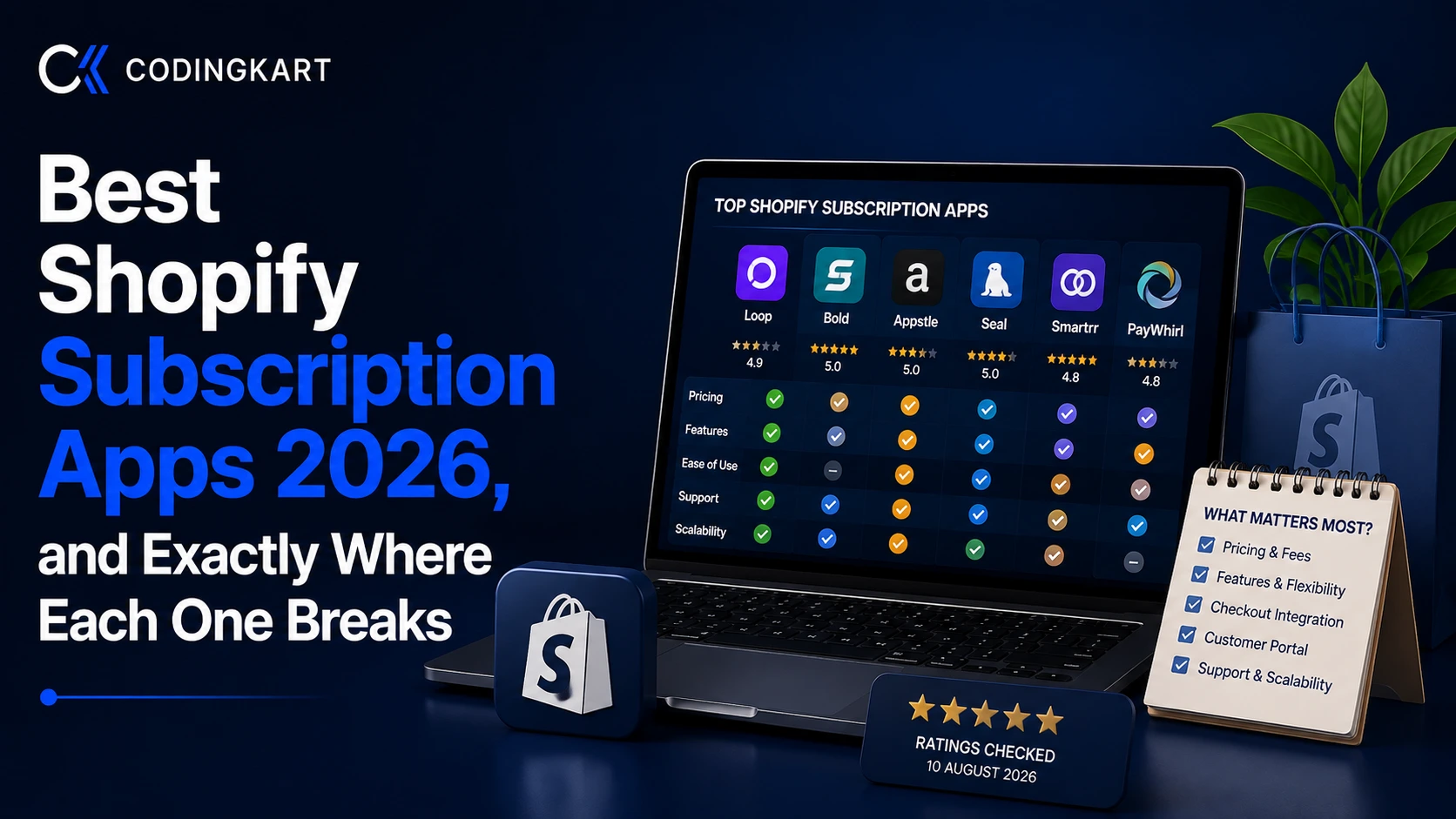
Appstle holds 5.0 stars across more than 8,000 Shopify App Store reviews. Loop sits at 4.9. Stay AI shows 5.0. Seal, Bold, Smartrr, PayWhirl and the rest all cluster between 4.8 and 5.0.
A metric on which every option scores near-perfect cannot help you choose between them.
The reason is not fraud. It is selection. Merchants rate the app that solved their problem, and every app in this category solves the standard problem well. The merchants who hit a wall two years in have long since stopped thinking about the review they left in month one.
There is a second distortion worth naming. A large share of the comparison content ranking for this term is published by companies that appear in it, and those posts rank their own product first. That is not dishonest exactly, but it means the shortlist you assembled from three blog posts may be three companies’ marketing pages.
We do not sell a subscription app, which is the only reason what follows can be written this way.
Even the ratings disagree with themselves. Stay AI’s App Store presence shows 5.0 across 139 reviews on one listing and 5.0 across 112 on another, which tells you how much precision to expect from the number.
What ratings do tell you is real: support responsiveness and how painful the install was. What they cannot tell you is where the ceiling sits, because nobody writes a review about a limitation they have not reached yet.
The five ways a subscription app breaks
Every failure in this category is one of five, and knowing which one is coming for you narrows nine options to two very quickly.
The fee curve. Percentage-of-GMV pricing compounds with your growth while flat pricing does not. There is a crossover, and it arrives sooner than founders expect. The rough industry figure puts zero-fee apps ahead until somewhere around $50,000 a month in subscription GMV, after which the tooling on percentage platforms starts earning its cost. Your number will differ, but the shape of the curve will not.
Checkout integration. Whether the app uses native Shopify Checkout decides whether Shop Pay one-tap works on the order that creates the subscription contract. That is your highest-intent moment, and a conversion difference there outweighs most feature comparisons.
The data model ceiling. What the platform can actually represent. A bundle whose components bill on different cadences. An entitlement calculated before inventory is consulted. A rotation constrained by a production calendar. These are not missing settings. They are things the underlying data model has no field for, and no amount of configuration reaches them.
Portal and retention depth. Dunning quality, cancel flows, self-service. This one breaks quietly, as churn you attribute to product rather than to a failed payment nobody retried properly.
The support model. Whether anyone will engineer against your specific problem. An app serving tens of thousands of merchants at $20 a month cannot staff bespoke work, and should not be criticised for it. The failure is not the app’s, it is choosing a mass-market price point for a business with non-standard requirements.
Four of these five are predictable before you sign. Only the data model ceiling tends to surprise people, because it depends on where your product goes next rather than where it is now.
| Break type | What you notice first | Typical trigger |
|---|---|---|
| Fee curve | Platform cost as a P&L line | Growth past roughly $50K monthly GMV |
| Checkout integration | Subscription conversion below one-time | Any volume |
| Data model ceiling | “Not supported” from support | New product format |
| Portal and retention | Rising churn, rising tickets | 6 to 12 months in |
| Support model | Slow answers on hard questions | Complexity, not size |
The nine apps, and exactly where each one breaks
Ordered by market position. Every one of these is a reasonable choice for somebody.
Verified against vendor pricing pages and App Store listings on 10 August 2026. This category rewrites its pricing several times a year, so check before committing.
Recharge has the deepest ecosystem, the widest integration surface, and the most mature API in the category. If you have a technical team and need to build custom flows on top of a platform, it gives you the most to build against. It also acquired Skio in April 2026 for $105 million, so those are now one company rather than two options. It breaks on the fee curve, because the percentage rides on all subscription GMV and grows with you indefinitely. We covered the exit routes in detail in our guide to Recharge alternatives in 2026.
Pick it anyway if you have engineers and intend to build on top of a platform rather than inside one. Nothing else here gives you as much surface to attach to.
Loop is built on Shopify’s native subscription APIs, carries no per-order flat fee, and its cancel-flow builder is among the strongest retention tooling available at accessible pricing. It is a sensible default for growth-stage DTC brands that want native checkout without an enterprise contract. It breaks on the data model ceiling: straightforward recurring products with retention layered on top are handled well, but products needing the platform to reason about things that are not products will outrun it.
Pick it anyway if your subscription is a product on a schedule and your real problem is churn. That describes most DTC brands honestly assessed.
Appstle has the largest install base in the category and charges no transaction fees on paid plans that start in the low tens of dollars. For a store under moderate volume the annual difference against a percentage platform runs into thousands, which is a serious argument that gets dismissed too casually. It breaks on the support model, because pricing that low is only possible by serving a very large number of merchants efficiently, and bespoke requirements get proportionally less attention.
Pick it anyway if your requirements are standard and you would rather spend the difference on acquisition. Paying a percentage of revenue for tooling you do not use is the most common overspend in this category.
Bold Subscriptions has the longest track record here and supports genuinely complex subscription logic and multi-channel ordering. Pricing is simple with no per-order fee. It breaks on extensibility, since platform age shows in the API surface, and its retention tooling is lighter than the platforms built specifically around churn.
Pick it anyway if you sell through more than one channel and need predictable costs. Longevity is worth something in a category that consolidates this often.
Stay AI positions on retention and experimentation, with AI-driven churn tooling and a portal built for subscriber lifecycle work. Its App Store listing shows a single plan at $499 a month plus 1% and 19 cents per transaction, verified 10 August 2026. It breaks on price floor: at that entry point it is an operator’s platform for brands with real subscription volume, and a smaller brand will pay enterprise pricing for tooling it has no data to feed.
Pick it anyway if you have enough subscribers that a percentage point of churn is a salary. Retention tooling needs volume to learn from, and below that volume you are buying a dashboard.
Smartrr builds the nicest subscriber portal in the category and folds loyalty and membership perks into the same app, which suits brands wanting subscriptions to feel like a club. Entry pricing sits near $99 a month plus roughly 1%. It breaks on automation depth, offering lighter predictive and lifecycle tooling than the platforms built around retention, and you pay for loyalty features you may not want.
Pick it anyway if your subscribers are a community rather than a convenience. A portal people enjoy using deflects support tickets, and that saving is real even though nobody reports it.
Seal Subscriptions offers a genuinely useful free tier, no transaction fees, and strong build-a-box for small and mid-sized shops. Setup is fast and migration is easy. It breaks on retention depth, and specifically on dunning: failed-payment recovery is thin compared with Loop, Recharge, or Smartrr, and involuntary churn is the most expensive kind because those customers wanted to stay.
Pick it anyway if you are early and cash matters more than recovered payments. Just know which number will eventually tell you to move, and watch it.
PayWhirl and Subify are cheap, simple, and fine for testing whether subscriptions work for your catalogue at all. Both break early on most axes, and that is the correct trade for what they cost. Use them to validate the model, not to run it.
Pick either if you genuinely do not know yet whether your customers want a subscription. Finding that out cheaply is worth more than starting on a platform sized for a business you do not have.
Shopify native Subscriptions is free, native, improving steadily, and entirely sufficient for a brand finding out whether recurring revenue makes sense. Starting here and outgrowing it beats paying for a platform you never needed. It breaks on portal and retention depth, where dunning, cancel flows, and subscriber self-service are thinner than anything paid.
Pick it anyway if you are launching. The cost of the wrong paid platform is not the monthly fee, it is the migration you run in month fourteen.
A caution that applies to every line above, including ours. A limitation is a limitation as of the day it was written, and all nine vendors ship continuously. Verify the specific constraint that matters to you rather than trusting anyone’s summary.
The comparison, on the axes that matter
| App | Fee shape | Best fit | First thing to break |
|---|---|---|---|
| Recharge | Monthly + % + per-order | Deep ecosystem, technical teams | Fee curve at scale |
| Loop | Monthly + %, no per-order | Growth-stage, retention-led | Data model on unusual logic |
| Appstle | Low monthly, 0% on paid plans | Cost-sensitive, standard needs | Support depth |
| Bold | Monthly + %, no per-order | Complex logic, omnichannel | Extensibility and API surface |
| Stay AI | $499/mo + 1% + $0.19 | High-volume, retention-focused | Price floor for smaller brands |
| Smartrr | ~$99/mo + ~1% | Premium portal, loyalty blend | Automation depth |
| Seal | Free tier, 0% fees | Small shops, build-a-box | Dunning and retention |
| PayWhirl / Subify | Low or free | Testing the model | Almost everything, early |
| Shopify native | Free | First subscription program | Portal and dunning depth |
Read down the last column and a pattern appears. The cheap apps break on capability. The expensive ones break on cost. Nothing in this category breaks on quality, which is precisely why the star ratings are useless and why every one of these has happy customers.
Any honest Shopify subscription app comparison ends up at the same place. The wrong question is which app is best. The right one is which failure you can most afford, and how long you have before you meet it.
Notice too that the column is not ordered by price. Stay AI and Seal sit at opposite ends of the cost range and both break on things the other handles well. Spending more buys you a different wall, not the absence of one.
Finding your breaking point before you hit it
Five things, and they take an afternoon rather than a quarter.
Model the fee curve twice. Calculate total annual platform cost at your current subscription GMV, then at three times that. Include the percentage, any per-order fee, and the plan tier you would be forced onto at that size. The winner frequently changes between the two calculations, and that is the whole decision.
Send your three hardest requirements to support. Not to sales. Write down the three most awkward things your subscription has to do and email them to each vendor’s support team. Compare the answers rather than the marketing pages. This costs nothing and reveals the data model ceiling before you sign anything.
Count your workarounds. Every spreadsheet, support macro, and manual monthly export that exists because your current setup will not do something. That list is your real feature gap, and it is more accurate than any comparison table including this one.
Ask what happens when you leave, before you arrive. Whether payment tokens transfer, whether historical orders come across as real order records or a flat export, and what the API lets you extract. Exit cost is decided the day you choose a platform.
Try to cancel your own subscription. As a subscriber, on your own store, on a phone. Most founders have never done this. If it takes more than three taps to skip a month, your churn number has an explanation that no retention feature will fix.
Run all five before booking a single demo. Demos are designed to show you the first eleven months, and you already know those will be fine.
What to do once you have broken it
Three routes, and they are not equally likely.
Switch apps. Right for most people. If your constraint is fee curve, portal depth, or support model, another platform in this list genuinely solves it, and the migration is a known quantity with a known cost.
Layer custom logic on top of what you have. Right for many. Your billing engine is fine and one specific piece of logic is not expressible. Keep the platform for what it does well and build the missing layer against its API. This is cheaper than replacement and far more common than founders assume.
Replace the subscription layer. Right for few. This makes sense when the constraint is structural rather than cosmetic, when percentage fees at your volume genuinely exceed a build’s amortised cost, and when subscription shares a customer record with a wider system. All three together, not one of them. We laid out that threshold honestly in our comparison of Recharge against custom development.
The mistake worth avoiding is treating route three as the ambitious version of route one. They solve different problems, and most brands reaching for a build actually needed a layer.
A useful test before committing to anything: write down the constraint in one sentence. If that sentence names a feature, switch apps. If it names a rule your product has that no platform models, build the layer. If it names your entire commercial model, only then consider replacing the platform underneath it.
Choosing for eighteen months from now
The category consolidated once already this year. Recharge bought Skio in April, taking two of the recognised leaders down to one company, and the merchants on both platforms found out from a press release.
That will happen again. It always does in a category with this many funded competitors and this much feature overlap, and the merchants affected are always the last to know.
Which changes what you should optimise for. The best Shopify subscription app for you is not the one with the longest feature list or the shiniest portal. It is the one whose breaking point sits furthest from where your business is heading, and whose exit is cheap if the roadmap you bought into becomes somebody else’s priority list.
Check the data portability before the feature list. Ask about the API before the demo. Work out which of the five breaks is coming for you, then pick the app that puts it furthest away.
Two more good years is a genuinely good outcome here, and be glad when you outgrow it. Outgrowing a subscription platform means the subscriptions worked.
Frequently Asked Questions
What is the best Shopify subscription app in 2026?
There is no single best. Recharge leads on ecosystem depth, Loop on retention at accessible pricing, Appstle on cost, and Shopify’s native app on getting started free. Choose by which constraint you will hit first at your volume and product complexity.
Which Shopify subscription app has no transaction fees?
Appstle charges no transaction fees on its paid plans, and Seal Subscriptions offers zero-fee plans including a free tier. Shopify’s native Subscriptions app is free. Zero-fee apps typically cost less until roughly $50,000 monthly subscription GMV.
Is Shopify’s native subscription app good enough?
For launching a first subscription program, usually yes. It handles selling plans and recurring billing natively at no cost. Brands typically outgrow it on portal depth, dunning, and cancel flows rather than on core billing.
Is Skio still available?
Skio now operates as part of Recharge, which acquired it on 30 April 2026 for $105 million. Both platforms continue running and a combined roadmap has been announced, so Skio is no longer an independent alternative to Recharge.
Which subscription app is best for build-a-box or bundles?
Seal Subscriptions and Appstle handle standard build-a-box well at low cost. Bundles whose components consume at different rates, or that need validation rules between items, exceed what any current app expresses and require custom logic.
How hard is it to switch subscription apps?
Harder than vendors suggest. The critical question is whether payment tokens transfer between platforms and gateways, because when they cannot, every subscriber must re-enter card details. Custom logic built on the old API also gets rebuilt rather than migrated.

 Get Started
