
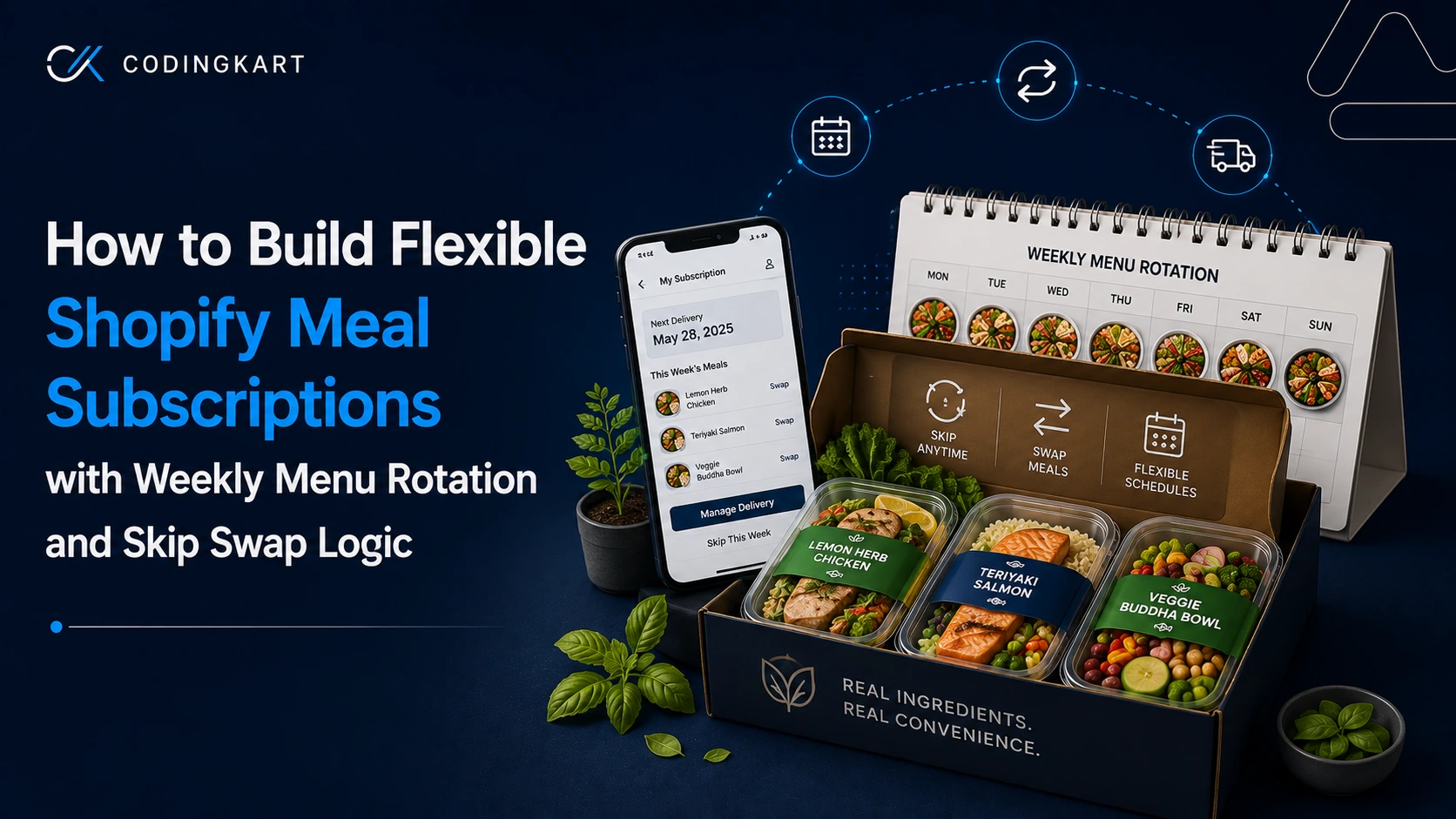
A customer swaps next week’s chicken meal for a vegetarian option just before your order cutoff. It looks like a simple request, but it immediately affects inventory, kitchen prep, packing lists, recurring billing, delivery schedules, and customer notifications. Multiply that by hundreds or thousands of subscribers, and flexibility quickly becomes an operational challenge rather than a product feature.
Many Shopify meal subscriptions launch with standard subscription setups because they make recurring orders easy to manage. That works until customers expect more control over their subscriptions. Weekly menu rotation, meal swaps, delivery skips, serving size changes, and recurring schedules all introduce dependencies that extend far beyond the checkout experience.
The real challenge isn’t offering flexibility. It’s ensuring every customer action triggers the right operational response without creating manual work or costly errors. When menu availability, order cutoffs, fulfillment planning, billing, and customer communication aren’t connected, even small subscription changes can disrupt your workflow.
The most successful Shopify meal subscription stores solve this differently. Instead of treating skip, swap, scheduling, and meal selection as separate features, they build them into a connected subscription system that supports both customer choice and operational efficiency. That approach makes it easier to scale recurring meal delivery without losing control of the processes running behind the scenes.
Why Meal Kit Subscriptions Are More Complex Than Traditional Subscription Models
Meal kits are one of the fastest-growing corners of subscription commerce — the global market was valued at around $39.4 billion in 2025 and is projected to reach $79.8 billion by 2033. But most subscription businesses ship the same product on a predictable schedule. A coffee subscription might send the same blend every month. A supplement subscription often follows a fixed replenishment cycle. Once the subscription is created, the operational workflow changes very little from one renewal to the next.
Meal subscriptions work differently because the product isn’t fixed. Your menu changes every week, ingredient availability can shift, and customers expect the freedom to customize upcoming deliveries. That means every recurring order depends on decisions that happen after the subscription has already been created.
Now imagine a customer swapping one meal for another a day before your order cutoff. That single change doesn’t stop at the customer portal. It affects inventory allocation, kitchen production, packing lists, delivery planning, and sometimes even supplier purchasing if demand changes across hundreds of subscribers.
The challenge grows even further when multiple operational rules overlap. Some subscribers pause deliveries during holidays, while others change serving sizes, update delivery frequencies, or switch meals based on the latest menu. Every choice needs to be reflected accurately across billing, fulfillment, and customer communication without creating manual work for your team.
This is why meal subscriptions require a different approach to meal subscription management. You’re not simply managing recurring payments. You’re coordinating customer preferences, operational workflows, and time-sensitive processes that all need to stay aligned.
The goal isn’t to remove flexibility. Flexibility is one of the biggest reasons customers choose meal subscriptions in the first place. The real challenge is designing a system where customer choices and operational execution stay connected, even as your subscription program grows.
Today’s Meal Subscription Customers Expect More Than Recurring Deliveries
A recurring subscription is no longer enough to keep customers engaged. People expect the same level of control they get from other digital services, where they can make changes without contacting support or waiting for someone to update their account manually.
One of the biggest expectations is weekly meal selection. Instead of receiving the same meals every renewal, customers want to choose from a rotating menu that reflects seasonal ingredients, new recipes, or personal preferences. That flexibility keeps subscriptions feeling fresh, but it also means recurring orders can’t rely on fixed product combinations.
Customers also expect to manage their own subscriptions. They want to skip a delivery, pause their plan during travel, swap individual meals, adjust serving sizes, or change delivery dates whenever their schedule changes. Every option reduces friction for the customer while adding another layer of operational logic behind the scenes.
Visibility matters just as much as flexibility. Customers want to know what’s arriving next, when they’ll be charged, and how much time they have to make changes before an order is finalized. A well-designed customer portal gives them confidence without creating additional work for your support team.
These expectations don’t exist in isolation. A customer who changes next week’s meals may also update their delivery date or adjust the number of servings for an upcoming renewal. Each action affects inventory planning, kitchen production, fulfillment, and billing. What feels like a simple preference on the front end often triggers multiple operational changes behind the scenes.
The expectation isn’t unlimited flexibility. It’s predictable flexibility. Customers want the freedom to manage their subscriptions within clear rules and deadlines. Building those guardrails into your subscription workflow is what allows you to deliver a smooth customer experience while keeping operations under control.
Why Flexible Meal Subscription Workflows Become Difficult to Manage
The complexity doesn’t come from offering meal swaps, delivery skips, or recurring schedules. It comes from making sure every customer action updates the rest of your operation accurately and at the right time.
Imagine a customer swaps next week’s Chicken Teriyaki Bowl for a Vegan Burrito Bowl two days before your order cutoff. From the customer’s perspective, it’s a quick change made through the subscription portal. Behind the scenes, that single update can trigger multiple operational changes.
Inventory needs to reflect one less chicken meal and one more vegan meal. Kitchen production may need to adjust ingredient quantities. Packing lists must include the correct meal. Billing may need to change if pricing differs, while delivery schedules and customer confirmations must stay accurate. If any one of these systems falls behind, the risk of shipping the wrong order increases.
Now multiply that scenario across hundreds or even thousands of active subscribers. Every week, different customers skip deliveries, swap meals, change serving sizes, update delivery dates, or pause subscriptions. Those changes don’t happen one at a time. They happen continuously, often within the same ordering window.
Order cutoffs add another layer of complexity. You need enough time to finalize menus, purchase ingredients, organize production, and prepare deliveries. If customers can make changes too close to fulfillment, your team loses the stability needed to plan efficiently. If cutoffs are too restrictive, customers lose the flexibility they expect. Finding the right balance is as much an operational decision as it is a technical one.
Many growing meal subscription stores also rely on several connected systems. Shopify manages the storefront, subscription software handles recurring billing, inventory tools track stock, fulfillment systems coordinate deliveries, and ERP or warehouse platforms support purchasing and production. Customer changes need to flow consistently between these systems to avoid manual corrections and data mismatches.
This is where meal subscription management becomes more than managing recurring payments. It’s about coordinating customer preferences, inventory synchronization, production planning, fulfillment workflows, billing, and delivery schedules as one connected process. The more flexibility you offer, the more important it becomes to design workflows that keep every part of your operation aligned.
The goal isn’t to remove customer choice. It’s to build operational rules that allow flexibility without creating unnecessary complexity. When those rules are planned from the beginning, your subscription program can grow without increasing manual work every time a customer makes a change.
Behind Every Flexible Meal Subscription Is a Connected System
Flexible meal subscriptions don’t succeed because they offer more features. They succeed because every customer action follows a defined operational workflow. When a subscriber skips a delivery, swaps a meal, or changes their schedule, those updates need to reach every system involved before production begins.
The challenge isn’t building individual features. It’s making sure those features work together without creating manual work, inaccurate orders, or fulfillment delays. That’s why successful Shopify meal subscription stores treat their subscription workflow as a connected system rather than a collection of independent tools.
Let’s look at the five operational systems that make that possible.
Weekly Menu Rotation Starts Long Before Customers Choose Their Meals
Customers only see the final menu. Behind the scenes, the work starts much earlier.
Before a new weekly menu becomes available, you need to confirm ingredient availability, production capacity, supplier timelines, pricing, and delivery schedules. Every meal you publish has operational consequences, so menu planning isn’t simply a merchandising task. It’s the starting point for the entire subscription cycle.
Once the menu is approved, it needs to appear at the right time inside your subscription workflow. Customers should have enough time to review upcoming meals and make changes before the order cutoff, while your operations team still has enough time to prepare ingredients, organize production, and finalize fulfillment.
Publishing menus too early can create unnecessary changes if availability shifts. Publishing them too late reduces the flexibility customers expect. Finding the right publishing window helps balance customer choice with operational stability.
Operational insight: Weekly menu rotation isn’t about introducing new recipes every week. It’s about creating a predictable planning cycle that gives both customers and operations enough time to make informed decisions.
Skip and Pause Rules Should Protect Operations, Not Just Customer Convenience
Giving customers the option to skip or pause a subscription improves retention because it offers flexibility without forcing cancellation. The real challenge is deciding when those changes can happen.
Every subscription should operate within clearly defined business rules. For example, you might allow customers to skip a delivery until 48 hours before the weekly order cutoff. After that point, production planning may already be complete, ingredients may have been allocated, and packing schedules may already be underway.
Without these guardrails, last-minute subscription changes create unnecessary operational disruption. Support teams may need to intervene manually, kitchen schedules become less predictable, and inventory planning becomes harder to manage.
Well-designed skip and pause logic protects both sides of the subscription experience. Customers understand exactly when they can make changes, while your operations team receives enough planning certainty to fulfill orders accurately.
Operational insight: Skip windows aren’t restrictions. They’re planning boundaries that allow customer flexibility without introducing fulfillment risk.
Meal Swaps Depend on Inventory, Production, and Availability
Meal swapping often appears simple from the customer’s perspective. Behind the scenes, it’s one of the most operationally connected actions in the subscription lifecycle.
Imagine a subscriber replaces a chicken-based meal with a vegetarian alternative. That decision changes ingredient demand, updates inventory allocation, affects production quantities, and alters packing instructions. If hundreds of subscribers make similar changes during the same menu cycle, those small adjustments become significant operational variables.
Not every meal should be available as a replacement either. Availability may depend on ingredient stock, production capacity, seasonal menus, or promotional limits. Your subscription workflow needs to evaluate these business rules automatically instead of relying on manual reviews.
Successful meal subscription stores treat swaps as controlled operational events rather than unrestricted customer actions. Clear availability rules and defined swap windows help maintain flexibility while keeping production and fulfillment aligned.
Operational insight: A meal swap isn’t simply a product change. It’s a planning decision that affects every stage of fulfillment.
Subscription Scheduling Keeps Every Team Working from the Same Timeline
A subscription schedule is much more than deciding whether customers receive meals every week or every two weeks. It acts as the operational calendar that coordinates every stage of your recurring meal delivery workflow.
Each delivery cycle should follow a clearly defined timeline. Menus are published first, giving customers time to review their upcoming order. They can then select meals, skip a delivery, or make eligible changes before the order cutoff. Once that window closes, production planning begins, inventory is finalized, recurring payments are processed, and fulfillment teams prepare shipments for delivery.
If those milestones aren’t connected, small timing issues can quickly become operational problems. A payment processed before meal selections are finalized can create billing discrepancies. A menu that stays open after inventory has been allocated can disrupt purchasing and kitchen planning. Even a delayed customer notification can increase support requests from subscribers who thought they still had time to make changes.
As your subscription program grows, scheduling also becomes more complex. Some customers receive weekly deliveries, while others follow bi-weekly or monthly cycles. Holiday schedules, delivery zones, and regional fulfillment calendars add even more variables. Your subscription workflow needs to account for these differences without requiring manual coordination every week.
The goal isn’t simply to automate recurring orders. It’s to establish a predictable operational rhythm where every team knows what happens next and when it happens.
Operational insight: A well-designed subscription schedule doesn’t just organize deliveries. It synchronizes menu planning, billing, production, fulfillment, and customer communication around the same timeline.
A Customer Portal Should Reduce Support Work, Not Create More
The customer portal is often viewed as a convenience feature, but its real value lies in reducing operational friction for both your customers and your internal team.
Subscribers should be able to manage common tasks without contacting support. That includes reviewing upcoming deliveries, selecting meals, skipping a week, pausing a subscription, updating delivery addresses, changing serving sizes, and viewing billing information. Every successful self-service action saves time while giving customers greater confidence in their subscription.
However, self-service should never mean unrestricted access. Every action within the portal needs to respect the business rules that keep operations running smoothly. If the order cutoff has passed, meal selections should no longer be editable. If a replacement meal has reached its inventory limit, it shouldn’t appear as an available option. These validations help prevent customer frustration while protecting production and fulfillment from unexpected changes.
A well-designed portal also creates transparency. Customers know exactly when they’ll be billed, when changes need to be made, and what meals are scheduled for their next delivery. Clear visibility reduces uncertainty, lowers support requests, and encourages customers to manage their subscriptions instead of cancelling them.
Some subscription businesses also allow customers to manage dietary preferences from their account. While this can improve personalization, it introduces additional operational complexity around menu eligibility and product availability. If you’re evaluating that challenge, our article on Where Dietary Filtering Breaks on a Shopify Meal Kit Subscription explores it in greater detail.
Operational insight: The best customer portals don’t simply give subscribers more control. They give them the right amount of control within rules that keep the rest of the operation stable.
Weekly menu rotation, meal swaps, skip requests, subscription schedules, and customer self-service aren’t independent features. They’re interconnected workflows that continuously exchange information throughout the subscription lifecycle.
When one part of the system changes, every connected process needs to respond in a predictable way. That’s what allows you to offer the flexibility customers expect without creating manual work or operational bottlenecks behind the scenes.
Where Standard Shopify Subscription Apps Reach Their Limits
Most Shopify subscription apps are designed to solve a common problem: managing recurring billing and recurring orders. For many subscription businesses, that’s exactly what’s needed. If every subscriber receives the same products on a predictable schedule, standard configurations can support the workflow with very little customization.
The picture changes as your subscription program becomes more dynamic.
Weekly menu rotation, customer-selected meals, inventory-aware swaps, flexible delivery schedules, and operational integrations introduce business rules that extend well beyond recurring billing. Instead of managing a fixed subscription, you’re coordinating a workflow where customer actions continuously influence production, fulfillment, and inventory planning.
Take meal swapping as an example. A customer replacing one meal with another isn’t simply updating an order. The system may need to verify ingredient availability, check menu eligibility, respect order cutoff windows, update inventory allocation, refresh production planning, and confirm that the change won’t affect the delivery schedule. The complexity comes from the workflow behind the action, not the action itself.
The same challenge appears when subscription data needs to move beyond Shopify. Many growing meal subscription businesses rely on ERP platforms, warehouse management systems, inventory software, shipping providers, and production planning tools. As recurring orders become more flexible, information has to flow accurately between these systems to keep operations synchronized.
This doesn’t mean standard Shopify subscription apps are the wrong choice. In many cases, they’re the fastest and most practical way to launch a subscription business. The challenge is recognizing when your operational requirements have outgrown a configuration designed for simpler recurring order models.
A good way to evaluate your current setup is to ask a few practical questions:
- Can customers swap meals without creating manual work for your operations team?
- Do inventory levels update automatically after subscription changes?
- Are production planning and fulfillment schedules based on the latest customer selections?
- Can different delivery frequencies, order cutoffs, and business rules coexist without creating exceptions?
- Does subscription data integrate reliably with your ERP, WMS, or other operational systems?
If the answer to several of these questions is no, the issue may not be the subscription app itself. It may be that your business has reached a level of operational complexity where connected workflows become more important than individual subscription features.
Operational insight: Subscription platforms don’t usually become limiting because they can’t process recurring payments. They become limiting when your business rules, operational workflows, and system integrations become more sophisticated than the original configuration was designed to support.
What a Scalable Shopify Meal Subscription Architecture Looks Like
As meal subscription operations become more flexible, success depends less on adding individual features and more on connecting the systems that support your day-to-day operations. Every customer action should move through a defined workflow, ensuring the right information reaches the right team at the right time.
Think of your Shopify store as the customer-facing layer rather than the center of the entire subscription operation. Customers browse menus, manage their subscriptions, and place recurring orders through the storefront, but the work that follows happens across several connected systems.
At the core is the subscription engine, which applies your business rules. It determines whether a customer can skip a delivery, swap a meal, change serving sizes, or update their delivery schedule based on menu availability, order cutoffs, and subscription policies. Instead of simply processing recurring payments, it coordinates how subscription changes move through the rest of the operation.
The menu management layer controls what customers can see and select during each subscription cycle. It publishes weekly menus, manages seasonal availability, and ensures meal choices remain consistent with inventory levels and operational capacity. Once the customer selection window closes, the finalized menu becomes the foundation for production planning.
The inventory and operational systems, often supported by ERP or warehouse management software, translate customer selections into purchasing decisions, ingredient allocation, production schedules, packing lists, and fulfillment tasks. Rather than treating subscription orders separately, these systems combine recurring demand with operational planning to create a more predictable workflow.
Communication is equally important. Automated notifications should keep customers informed about menu availability, order cutoffs, billing dates, successful meal swaps, delivery confirmations, and any changes affecting upcoming orders. Clear communication reduces uncertainty and encourages customers to manage their subscriptions confidently instead of contacting support.
Finally, your admin dashboard should provide operational visibility rather than just subscription metrics. Teams should be able to monitor upcoming production volumes, menu demand, inventory availability, fulfillment status, customer changes, and operational exceptions from a single place. That visibility allows problems to be identified before they affect deliveries.
The goal isn’t to build a complex technology stack. It’s to create an ecosystem where Shopify, subscription management, inventory, fulfillment, and customer communication work together as a coordinated system. As your subscription program grows, that connected architecture becomes the foundation for delivering flexibility without increasing operational complexity.
Operational insight: Scalable meal subscription systems don’t rely on one platform doing everything. They rely on clearly defined responsibilities and reliable communication between connected systems.
Best Practices for Scaling Flexible Meal Subscription Operations
Scaling a meal subscription business isn’t about introducing more flexibility at every opportunity. It’s about adding flexibility in ways that your operations can consistently support. Every new option you offer should fit within a workflow that remains predictable for your team and reliable for your customers.
Define Order Cutoff Windows Early
Customers appreciate flexibility, but they also need clear expectations. Define when meal selections, skips, swaps, and delivery changes must be completed for each subscription cycle.
Cutoff windows give your purchasing, production, and fulfillment teams enough time to prepare without constant last-minute adjustments. They also reduce customer confusion by making deadlines transparent instead of surprising subscribers after an order has already entered production.
Publish Menus on a Predictable Schedule
Consistency matters just as much as variety.
Whether you release new meals every Monday or every Friday, customers should know exactly when to expect upcoming menus. A predictable publishing schedule encourages subscribers to engage with their accounts regularly and helps operations maintain a repeatable planning cycle.
Avoid changing publication dates unless absolutely necessary. Even small inconsistencies can affect meal selection timelines and operational planning.
Keep Customer Choices Simple
Offering unlimited flexibility may sound appealing, but too many choices can create unnecessary operational complexity.
Instead, provide meaningful options within clearly defined boundaries. Allow customers to swap eligible meals, choose serving sizes, or skip deliveries while using business rules to protect inventory, production capacity, and fulfillment schedules.
The goal is to give customers confidence without overwhelming them or your operations team.
Keep Inventory and Subscription Data Aligned
Inventory planning shouldn’t happen independently from subscription management.
Customer selections, meal swaps, skipped deliveries, and recurring schedules all influence ingredient demand. Keeping inventory synchronized with subscription data helps purchasing teams make better decisions while reducing waste and minimizing the risk of unavailable meals.
The earlier inventory reflects customer changes, the easier production planning becomes.
Design for Tomorrow’s Operations, Not Today’s
Many subscription workflows perform well when managing hundreds of recurring orders. The real test comes as subscriber numbers increase, delivery regions expand, or operational rules become more sophisticated.
Building scalable workflows from the beginning reduces the need for major operational changes later. Instead of redesigning processes as complexity grows, you can expand on a stable foundation that already supports flexible subscription management.
Operational insight: The most scalable subscription workflows aren’t the ones with the most features. They’re the ones that continue operating predictably as customer volume, menu complexity, and operational demands increase.
When Your Subscription Workflow Outgrows Standard Configurations
Every meal subscription business starts somewhere. In the early stages, a standard subscription setup is often enough to validate your idea, automate recurring billing, and manage a predictable delivery schedule. There’s no advantage in building custom functionality before your operations require it.
The decision becomes different as your subscription model evolves.
If you’re introducing weekly menu rotation, inventory-aware meal swaps, multiple delivery frequencies, customer-specific business rules, or integrations with ERP and fulfillment systems, you’re no longer managing a simple recurring order model. You’re coordinating an operational workflow where customer actions influence multiple systems across your business.
At this stage, the question isn’t whether your current subscription platform works. It’s whether it supports the way your business actually operates.
You may find yourself relying on manual processes to bridge gaps between systems. Customer changes might need to be reviewed by your operations team before they reach production. Inventory updates may require additional checks, or recurring orders may need to be adjusted outside the normal workflow. These workarounds often become more frequent as subscription volume grows.
Custom Shopify subscription development allows those workflows to reflect your business instead of forcing your business to adapt to software limitations. Rather than building around fixed configurations, you can design subscription logic that aligns with your menu planning, inventory rules, fulfillment processes, customer portal, and operational integrations.
That doesn’t mean replacing every tool you already use. In many cases, it means extending your existing Shopify ecosystem with custom workflows, integrations, or applications that solve the specific challenges unique to your subscription model.
If your subscription program depends on dynamic menus, operational automation, or business rules that continue to grow in complexity, custom development becomes less about adding features and more about creating a system that can scale with confidence.
Operational insight: The strongest subscription systems aren’t the ones with the most customization. They’re the ones where every workflow reflects how the business actually operates.
A Practical Way to Evaluate Your Current Setup
Before deciding whether custom development is the right next step, ask yourself:
- Can customers manage their subscriptions without creating manual work for your team?
- Do menu changes automatically update inventory, production planning, and fulfillment?
- Are your operational systems connected, or does information need to be transferred manually?
- Can your subscription workflow support new delivery models or business rules without significant rework?
- Will your current setup continue supporting your operations as subscriber volume grows?
If several of these questions reveal recurring bottlenecks, your subscription platform may not be the problem. The challenge may be that your operational workflows have become more sophisticated than your current architecture was designed to support.
Customers don’t think about subscription architecture when they choose a meal, skip a delivery, or swap a recipe. They simply expect every change to work without friction. Behind that experience is a network of connected workflows that keeps menus, inventory, production, billing, fulfillment, and customer communication aligned.
As your subscription program grows, flexibility stops being a customer-facing feature and becomes an operational responsibility. Every new option you introduce, from weekly menu rotation to meal swaps and delivery changes, increases the need for systems that can respond consistently without creating manual work behind the scenes.
Building a successful Shopify meal subscription isn’t about offering the most features. It’s about creating workflows that balance customer choice with operational control. When those workflows are thoughtfully designed, you can continue improving the subscriber experience while keeping your operations predictable, efficient, and ready to scale.
The businesses that scale successfully don’t treat flexibility as a feature. They treat it as the result of well-designed operational workflows. When every system works together, you can continue meeting changing customer expectations without making your operations harder to manage.

 Get Started
