
Aug 18, 2026
7 min read
The Technical Stack Behind a Coffee Subscription That Ships Fresh
Is Your Stack Actually Connected?
We wire billing, roast planning, and fulfillment into one flow for coffee brands on Shopify.
See How We BuildAsk ten roasters what their subscription runs on and nine give the same two words: Shopify and an app. Then ask how many days off roast the average subscriber bag ships, and the room gets quiet.
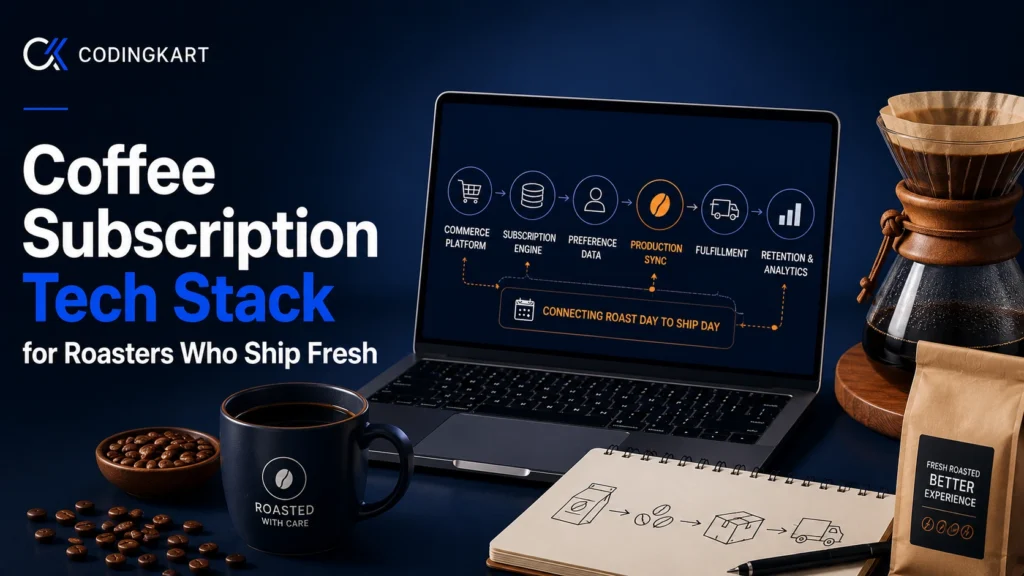
Here is the honest map. A coffee subscription that ships fresh runs on six layers: commerce platform, subscription engine, preference data, production sync, fulfillment, and the retention and analytics layer that pays for the rest. Most roasters run three of them well and improvise the other three in spreadsheets.
The improvised ones are always the coffee ones. Nothing in an app store connects a charge queue to a roast log, and that connection is the whole difference between subscription coffee and fresh subscription coffee.
The same layer map runs a kombucha subscription stack, and skincare gets its own version too. Coffee earns this one because a roaster sits in the middle of it. Each layer below gets the same treatment: what runs it, what it hands downstream, and where it usually breaks.
Layer 1: The Commerce Foundation
The platform argument ended a while ago. Shopify carries native selling plans, the subscription APIs everything else builds on, and the app ecosystem, while Plus adds checkout extensibility once volume justifies the bill.
What this layer owes the next one is precise: a subscription order carrying the right selling plan, the right variant, and the preference data attached. Most stores fumble that handoff at checkout.
Coffee checkouts carry more weight than most, because frequency, grind, and first-box expectations all get decided in about ninety seconds. Checkout flows built around subscription choices win or lose the subscriber before any retention tool wakes up.
Layer 2: The Subscription Engine
Every charge, skip, swap, and dunning email comes from one place. For most roasters that place is an app, and the current field of subscription apps is genuinely strong on billing, retries, and portals.
Billing is not where engines fail coffee. Rotation with memory, roast-day timing, grind handling, and lot allocation all sit past what any of them ship, and the five logic gaps no subscription app closes mark that boundary in detail.
The pattern that works at scale is engine plus layer. The app keeps the cards, the retries, and the compliance. A custom layer owns the coffee logic and speaks to everything below it.
Layer 3: The Preference Layer
Roasters file the quiz under marketing. It belongs under infrastructure.
A well-built coffee quiz is the one moment a subscriber hands over brew method, roast preference, and adventure tolerance in structured form. Where those answers land decides whether they ever matter again.
Landed right, they sit as data on the customer and the subscription contract, readable by rotation logic, cadence models, and cohort reports. Landed wrong, they sit in a welcome email nobody reopens.
Layer 4: Production Sync, the Layer That Makes It Coffee
Here is the layer you cannot install, and the reason a coffee stack is not a skincare stack with beans.
The job sounds simple: turn Sunday’s settled charges into Tuesday’s roast plan. Demand aggregates by coffee, batch size, grind, and bag size, lands in front of the roaster, and nothing ships until its batch clears the cupping table.
Real tooling covers real pieces of it. Cropster Commerce pulls Shopify orders into roast schedules, pick lists, and bean-to-bag traceability, and RoasterTools plans production around subscription products and pairs with the major engines. Artisan logs roast curves for teams who keep software minimal.
All of them plan from orders that already exist. A subscription knows its demand days earlier, sitting in the upcoming-charge queue, and no roasting tool listens there on its own. Wiring that handoff, charge queue to roast plan to fulfillment hold to printed roast date, is systems integration work, and it is the piece no vendor sells.
One picture holds the whole thing:
Fresh is not a shipping speed. Fresh is a working connection between the charge queue and the roast log.
Layer 5: Fulfillment and the Roast-to-Ship Gap
Two-day shipping on ten-day-old coffee is still ten-day-old coffee.
The number that matters is roast-to-ship, not ship-to-door. A bag roasted Tuesday, rested a day to degas, and handed to the carrier Wednesday arrives inside its best weeks almost anywhere domestic.
In-house pick and pack keeps that gap short by default. A 3PL can match it only when the production layer feeds it release events instead of a standing pile of open orders, which is why perishable brands treat 3PL selection as an integration decision first and a rate card second.
Shipping software closes the layer: rates, labels, tracking, all replaceable in an afternoon. It is the most interchangeable tool in the stack and, in most roasteries, the only one fully wired.
Layer 6: Retention and Analytics, Where the Stack Pays Rent
What does all of this owe you back? Two things: fewer cancellations and better answers.
The cancellation side is mostly flows. Pause, skip, and swap options catch a wobble before it becomes a cancel button, and the churn levers roasters actually control run from cadence fixes to win-back timing.
The answers side is where the earlier layers pay off. Quiz answers become cohort keys, rotation history shows which origins keep subscribers, and the frequency histogram reveals whether cadence matches consumption.
None of it exists if the layers below never wrote their data down. Analytics is not a tool you add at the end. It is the exhaust of a stack that was wired properly from the start.
Five Checks That Read Your Current Stack
Run these against your own setup this week:
- Demand visibility. Can your roaster see Thursday’s exact demand today, by coffee and grind, without a spreadsheet export?
- Preference flow. Does a quiz answer change what actually ships, or does it end its life as an email tag?
- Hold capability. If a batch fails cupping tonight, can you pause exactly its orders in one action?
- Label truth. Does the roast date print itself onto the bag, or does someone type it?
- Data return. Can you pull retention by origin or roast level in one report?
Five yes answers mean the layers are connected. Anything less means you own six tools and zero stack.
FAQ
What software does a coffee subscription business actually need?
Five categories: a commerce platform like Shopify, a subscription engine such as Recharge, Appstle, or Skio, a quiz or preference tool, roast planning software like Cropster Commerce or RoasterTools, and shipping software. The sixth requirement is the integration layer that connects them, which gets built rather than installed.
Does Shopify work for coffee subscriptions?
Yes. Shopify carries native selling plans and subscription APIs, every major subscription engine, and direct order feeds into roast planning tools like Cropster Commerce. Shopify Plus becomes worth it when checkout customization and higher API limits start earning their cost, usually well past the first thousand subscribers.
Do I need Cropster or RoasterTools to run a subscription?
Not at low volume. Both plan production from existing orders and remove the spreadsheet from roast day, which matters more every week you grow. Neither reads a subscription’s upcoming-charge queue on its own, so subscription-ahead demand still arrives through an integration layer you add.
How do roasters keep subscription coffee fresh in transit?
By shrinking roast-to-ship, not by paying for faster carriers. Bags that leave within a day or two of roasting arrive inside their best window on standard domestic services. The mechanics behind that are fulfillment holds until a batch clears QC, then immediate release to the shipping queue.
Can this stack run without custom development?
Yes, in the single-cohort shape: one charge day, one shared rotation, one monthly roast plan. Growth past that shape brings per-subscriber rotation, grind preferences, and roast-day orchestration, and those live in a custom layer between the engine and the roastery tools.
About the author

Failed a Few of the Five Checks?
Tell us what you run today. We will map the missing connections in order.