
Jul 31, 2026
9 min read
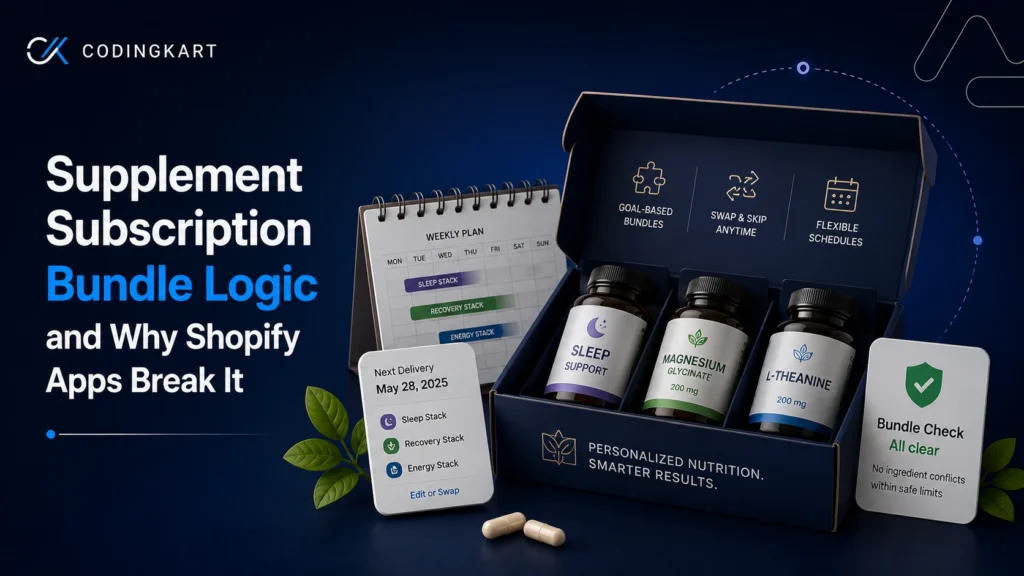
Supplement Subscription Bundle Logic and Why Shopify Apps Break It
Build Smarter Shopify Supplement Subscription Experiences
Move beyond basic bundle apps with custom Shopify subscription logic built for health goals, ingredient rules, dosage tracking, and personalized protocols.
See what we buildTwo of your stacks contain magnesium.
The Sleep Stack carries 200mg of glycinate. The Recovery Stack carries 400mg of citrate. Both are sensible alone. A customer subscribed to both takes 600mg a day, and there is no screen anywhere in your store where those two numbers meet.
She finds out eventually, then emails support asking whether she should worry.
That email is cheap. What follows is not. The thread becomes a refund, the refund becomes a cautious review, and around the fifth one a founder decides the bundle builder causes more trouble than it solves and quietly switches it off.
That is almost always the wrong call. A supplement subscription bundle built around a health goal asks your store a question it has no field to answer. Data problem long before feature problem, and switching the feature off does not fix the data.
Category bundles vs. goal bundles
Nearly every bundle app on Shopify was built for merchandising. Buy any three proteins, save 15%. Take 20% off a vitamin multipack.
Call those category bundles. Items come from a defined list, any combination works, and the discount is the entire reason the bundle exists.
Protocol brands do not organise by shelf. They organise by outcome: energy, sleep, gut. Someone choosing a gut protocol is not buying three products at a saving. She is buying a result, and the items are your professional answer to how that result gets reached.
That difference changes what the bundle has to know about itself.
A category bundle needs a list of eligible products and a price rule. Nothing more. A goal bundle needs to know which items are essential, which are optional, which two must never share a box, and what happens to the rest when one comes out.
The apps are not badly built. They answer a different question, and answer it well.
Every one of them handles the first case. The second is where supplement brands lose months, usually after the builder is already live and the edge cases have started arriving.
Why products aren’t independent once they’re bundled by goal
Ask your formulator why the sleep protocol contains those three items and you get a careful answer about mechanisms, timing, and dose. Ask your bundle app the same question and it has nowhere to put the answer.
Actives overlap without anyone noticing. Two items each carry 2,000 IU of vitamin D. Fine individually. Together your customer takes 4,000 IU daily for a year, and nothing in the purchase flow adds those figures up, because your platform thinks in SKUs while the dosage overlap in a supplement subscription lives down in the compounds.
Combinations that should never exist sail straight through. Someone drops a morning thermogenic into a sleep stack. Both products are in stock, both subscription-eligible, and the cart accepts it without comment. Your page invited her to build her own stack, so she reasonably assumes the store checked her work. Every supplement bundle ingredient conflict you ship began as a combination nobody asked the store to evaluate.
Dependencies break the most quietly of all. Iron absorbs considerably better alongside vitamin C. Take the vitamin C out and the iron still ships, still bills, and does noticeably less. Your subscriber concludes the product does not work and cancels for a reason your exit survey will never surface.
The name outlives the thinking behind it, too. “Sleep Stack” tells a customer you assembled it deliberately. The moment she edits it in the portal, the label stays and the deliberation goes.
The serious end of the category treats this as basic hygiene. Persona Nutrition, the Nestlé Health Science personalisation business, screens every plan it builds against a database of more than 4,000 drug-nutrient interactions before anything ships, with pharmacists reviewing what comes out.
Once customers assemble their own combinations, interaction checking stops being a formulation question and becomes a runtime one. Something has to run it on every order, forever.
That is the real gap inside a goal-based supplement bundle. Bundle logic written for health goals has to reason about ingredients, and most Shopify supplement brands carry that risk with an app that has no concept of one.
Building the goal-to-product mapping in Shopify
The abstraction that works is not goal-to-product. It is goal-to-role-to-product.
Give every item in a protocol a role. Foundation items appear in most stacks for that goal and rarely come out. Targeted items address the particular version of the goal your customer picked. Performance items are optional extras that assume the foundation is already there.
Roles matter because they tell your system what a removal means. Pull a performance item and the protocol survives. Pull a foundation item and it does not, which is exactly when your builder should say something instead of nodding along.
Shopify has genuine primitives for holding this.
Product tags are the crude version, and plenty of stores start here. A tag like role:foundation is readable, filterable, and free. It also cannot carry a number, so it breaks the moment you need a dose.
Metafields are custom fields you attach to a product, and this is where the per-item facts belong: active compound, amount per serving, servings per container. Using Shopify metafields for product bundling is unglamorous work, and everything downstream depends on it. If servings-per-container is not on the product, no amount of clever logic can compute what your customer actually needs.
Metaobjects hold the goal definition itself. Think of one as a custom record type you design. A health_goal object carries required roles, eligible products per role, pairs that must never combine, and combined-dose ceilings. Shopify Functions read app-owned metaobjects at runtime, so your validation logic and your merchandising team finally work from one record instead of two.
Selling plans sit underneath all of it. A selling plan is Shopify’s definition of how a product gets sold on a recurring basis, covering frequency, discount, and delivery policy. Recharge, Appstle, Skio, and Loop all manipulate selling plans beneath their own interfaces.
A supplement subscription selling plan on Shopify handles billing cleanly. What it cannot express is any relationship between the items it bills for.
Where the logic breaks at checkout and renewal, not just in the builder
Most teams build the stack experience on the product page, watch it work, and assume the hard part is done.
Shopify’s own documentation says otherwise.
The Cart Transform Function API is Shopify’s native machinery for bundling. It expands a bundle into components, merges components into one line, and controls how that line looks. On its compatibility table, Shopify states that it rejects lineExpand, linesMerge, and lineUpdate operations when a selling plan is present, and lists subscriptions as not supported.
Read that twice. Shopify’s own bundle mechanism does not work on subscription lines. Not a bug. The platform’s documented position.
So every build-your-own-subscription-stack experience on Shopify is doing something else underneath. Usually the grouping lives inside Recharge or Appstle, in a schema Shopify cannot see. Your app knows those three items form the Sleep Stack. Shopify Functions do not. Shopify Flow does not. Your 3PL certainly does not.
That holds together until something changes.
Rules you enforce at checkout have to run again before every renewal. A stack valid in March can be invalid by September, because she swapped an item, you reformulated one, or you pulled a SKU from her region. You validated once. The subscription renews indefinitely.
Worth doing today: reformulate a product in a live protocol, then look at what your subscribers are scheduled to receive next month.
Different components, different reorder cadence
There is a second mismatch sitting underneath the first.
A 60-count bottle at two capsules a day lasts 30 days. A 90-count softgel at one a day lasts 90. Put both in one stack on a single monthly cadence and your customer collects surplus softgels two months in three while running dry on capsules.
A selling plan carries one interval. Your stack has three consumption rates.
The maths takes ten seconds. The reason nobody runs it is that servings-per-container sits in a metafield your billing system has no reason to read.
Same mechanism behind the pattern in why supplement subscribers cancel in month three, multiplied by however many components sit in the bundle. Four items give a customer four separate chances to notice your shipping schedule has nothing to do with how she takes the product.
Fixing it properly is its own build, and its own article.
A brief compliance note
One flag for anyone naming bundles after outcomes.
Under DSHEA, supplement marketing lives inside a structure-function lane, and the boundary you cannot cross is a disease claim. “Supports restful sleep” sits on one side of it. “Treats insomnia” sits on the other. A bundle name is marketing copy like any other.
The engineering consequence is narrow. Approved wording belongs on the bundle record and needs versioning, so renaming a protocol in admin cannot quietly push unreviewed language live. A DSHEA compliant supplement subscription on Shopify treats claim text as controlled data, not an editable field.
If you’ve outgrown Recharge or Appstle, this is a build problem
Recharge, Appstle, Skio, and Loop are good software. Plenty of our clients stay on them for years, with custom logic layered on top.
They share one assumption. A subscription is a customer, a product, and a frequency.
Protocols break that in four places at once. The product is a set, the set carries internal rules, the components run out at different rates, and the whole thing needs revalidating on a schedule.
That is the honest edge of Shopify subscription app limitations, and where custom Shopify subscription development earns its cost. We hit the same shape at ChiDog, where a diet plan resolves into specific products at specific cadences and Recharge alone could not express it.
Count your workarounds. One spreadsheet is a process gap. A support macro, a manual combination audit, and a monthly cadence export is a system out of room.
Your customer bought a protocol. Build a store that can ship one.
About the author

Need Custom Logic for Your Shopify Subscription Store?
Whether you need goal-based bundles, subscription validation, or advanced product personalization, our Shopify experts can build the right solution for your store.