
Aug 09, 2026
12 min read
Wine Club Allocation for Release Day Drops and Limited Inventory
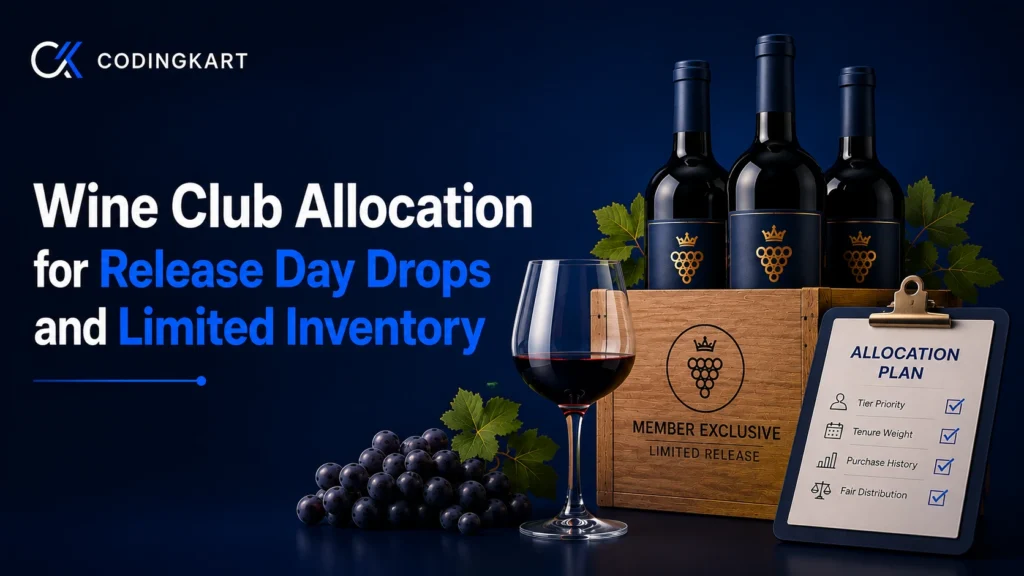
Pre-Reserved Allocation Is a Build, Not a Setting
Entitlement rules, reservation ledgers, and claim windows are custom subscription engineering your club platform does not ship with. We scope and build them for wine clubs.
See How We BuildTwo hundred and forty bottles. Nine hundred members. The email goes out at nine.
By 9:04 the release is gone. By 9:20 your inbox holds the message you were dreading, from a member who joined in 2016, has sat in your top tier ever since, and got nothing. She has already seen that someone who joined last spring posted two bottles to Instagram.
Nothing malfunctioned. Inventory tracked correctly, payments cleared, the orders are clean. Your platform will file that release as a four-minute sell-out and call it a success.
The failure is quieter than an oversell and costs considerably more. Your best member just discovered that eight years of loyalty was not written down anywhere your store could read.
Wine club allocation is a rule set that decides how much of a scarce release each member may buy, calculated before inventory is ever consulted. That last clause is where most clubs come apart, because most setups run it the other way around.
Allocation is an entitlement system, not an inventory system
Your inventory system answers one question. Is there stock.
Allocation answers a different one. Who is permitted to buy this, and how much may they take.
Those questions feel adjacent, and nearly every club platform treats the second as a flavour of the first. Set a stock number, open the gates, let the count do the work. That holds up perfectly well while you have enough wine for everyone who wants it, which is to say while allocation does not really matter.
Short supply separates them. For limited release wine club members, inventory is a single counter attached to a SKU, and it knows nothing about the person reaching for it. Entitlement is a calculation per member, drawing on tier, tenure, purchase history, and what that member received in the last three releases.
A counter cannot express any of that. It counts down and stops.
Winery DTC allocation logic has to sit above inventory and decide entitlement first, then hand a number to the counter.
So when a release sells out in four minutes, your store has not made a decision about fairness. It has declined to make one, and speed decided instead. The member with a fast connection, a saved card, and a free Tuesday morning outranks the member who has bought every vintage since 2016.
Wineries rarely intend that outcome. They inherit it, because the entitlement layer was never built and the inventory counter was standing there ready to do something that looked close enough.
The distinction matters for a practical reason too. Entitlement can be calculated in advance, quietly, the night before. Inventory can only be consumed live, under load, at the worst possible moment.
Four ways to decide who gets what
Fairness sounds like a values question. Build one of these and it becomes an arithmetic question with consequences.
Flat pro-rata gives every participating member the same quantity. It is the simplest rule to build and the easiest to explain in an email. It also tells your founding members that a decade of renewals buys them precisely what a three-month member gets.
Tier-priority lets higher tiers draw first, and it is what most clubs reach for. Members understand it instantly because they bought into the tier on that promise. The cost is a hard cliff at every tier boundary, and members sitting just below one feel it sharply.
Tenure-weighted scales allocation with months of continuous membership. It feels fairest to long-standing members and reads well in an announcement. It also demands clean, unbroken membership history, and it quietly punishes anyone who paused a shipment during a house move.
Purchase-history weighted scales allocation with trailing spend or with how much of past allocations a member actually claimed. It produces the best revenue outcome and rewards the behaviour you want. It is also the hardest rule to explain to someone who did not get any wine.
| Model | Optimises for | What it costs you | Data you must already hold |
|---|---|---|---|
| Flat pro-rata | Simplicity, perceived equality | Loyalty signals nothing | Active member list |
| Tier-priority | Clarity, tier upgrades | Hard cliff at boundaries | Tier assignment, join date |
| Tenure-weighted | Long-term retention | Penalises pauses | Unbroken membership history |
| Purchase-history | Revenue per release | Hard to explain, data-hungry | Trailing spend, past fill rates |
Most clubs blend two, usually tier as the base with tenure breaking ties inside it. Allocation tiers in a wine club work best when each tier maps to a stated bottle range rather than a vague promise of priority.
Whichever you choose, the rule has to live in your data model rather than in your club manager’s judgement. A rule that exists only in someone’s head cannot run twice the same way, cannot be audited when a member disputes it, and cannot survive that person taking a holiday in the middle of a release.
Your cart is not a reservation
Ask a club manager what happens when a member adds three bottles to their cart, and most will tell you the bottles are held.
They are not.
Shopify’s engineering team described the mechanism in May 2026: oversell protection reserves inventory during payment processing, a short hold that stops two concurrent checkouts from claiming the same unit. The reservation exists to make the moment of purchase correct. It is not a promise extended to anyone browsing.
Between your email landing and a member’s payment clearing, nothing is held for them.
Picture what that means for the member who has been with you since 2016. She opens the email on her phone, adds three bottles, then goes to find the card she does not have saved. Ninety seconds later she returns and the checkout fails. She never sees a tidy sold-out message on the product page. She sees an error at the last step, after she believed the wine was hers.
That experience is worse than being told no at the start. You gave her the bottles and took them back.
The Shopify App Store carries apps that hold cart items for fifteen minutes precisely because merchants keep hitting this. Their existence is good evidence the gap is real.
A timed cart hold is still a different mechanism from an entitlement. A hold is a countdown you race against. An entitlement is something the member already owns and claims when convenient. Wine club inventory reservation done properly looks like the second, not the first, and the two are easy to confuse because both put bottles behind a member’s name on a screen.
Here is the architectural move that follows. Allocation should be reserved against the member before the release opens, not raced for after it does.
A drop where members compete is a design choice. Sneaker brands make that choice deliberately, because the scramble is the marketing. Wineries usually inherit it by accident, then spend release day apologising for it.
Your members did not buy membership so they could be quick. Most of them bought it so they would not have to be.
Queue, hold, or pre-commit
Three patterns cover almost every release you might run.
Open race. Nothing is reserved, first checkout wins, and the fastest member takes the wine. Cheapest to build because it is what you get by default. Correct only when supply comfortably exceeds demand, which is the situation where allocation stops mattering anyway.
Pre-reserved allocation. You calculate entitlement before the release, hold each member’s bottles against their account, and give them a window to claim or decline. The race disappears entirely. This needs a reservation ledger, and your commerce platform does not provide one, because reservations of this kind are not a commerce primitive.
Queued release. Everyone competes, but in a controlled order with server-assigned positions rather than whoever’s browser fires first. Useful when scarcity itself is the story you are telling, and when a public scramble builds the mailing list.
| Pattern | Member experience | Build effort | Right when |
|---|---|---|---|
| Open race | Stressful, arbitrary | None | Supply exceeds demand |
| Pre-reserved | Calm, claim at leisure | High | Entitlement is the promise |
| Queued | Fair scramble, still a scramble | Medium | Scarcity is the marketing |
For most wine clubs the answer is pre-commit, and it is not close.
Queueing solves the wrong problem. It makes a race orderly without questioning whether there should be a race. If your members already pay an annual fee for priority access, asking them to compete for that access at nine in the morning undoes the thing they paid for.
The build effort is real, which is why so few clubs do it. So is the retention effect of a member opening an email that says three bottles are already set aside in her name.
What breaks on release day that never breaks in testing
Every one of these behaves perfectly with five test orders and falls over with nine hundred real ones.
Multiple active inventory locations. Shopify’s own flash sale guidance recommends deactivating every location except the one holding the sale stock, because multiple active locations can slow your storefront or produce outright checkout errors under load. A winery with a tasting room, a warehouse, and a 3PL has three.
Payment latency. The same documentation warns that third-party payment methods can cause overselling, because the checkout has to travel to an external service and back before it completes. Wine club demographics skew older and slower on payment paths, which widens that window on exactly the members you least want to fail.
Mid-release corrections. Allocation platforms generally will not let you edit a release once it is running. OrderPort’s documentation is explicit about the workaround: finish the current release, correct the wine, then start a new one. Build every release assuming you cannot change it in flight, because you cannot.
Email send time against release open time. If your ESP takes eleven minutes to work through nine hundred sends, you have built a queue ordered by nothing at all. The member at the end of the send list competes for wine that vanished before her email arrived.
Worth doing this week: pull your last release, and check whether any member received bottles their tier did not entitle them to. If the answer is yes, or if you cannot tell from your own records, the entitlement layer is not enforcing anything.
The second wave: what to do with what nobody claimed
Every allocation leaves a remainder.
Members decline. Windows expire. A percentage never open the email at all, and their bottles sit in a reserved state with nobody coming for them.
The standard answer is a wishlist, or an above-allotment request, where members register interest in more than their entitlement and receive it if stock remains. Wine club allocation software has supported this pattern for years, and it is one of the clearest signals that a platform was designed for genuine scarcity rather than for scheduled shipments.
What it demands is easy to miss. The second wave has to be ordered by the same fairness rule as the first, or you have just handed the remainder to whoever refreshes most often and undone the entitlement logic you spent a quarter building.
Timing is the other half. Release the remainder too early and you punish members still deciding. Too late and the wine sits through a season it should have sold in.
Both of those deserve their own treatment, and they will get it.
A brief compliance note
Allocation decides who may buy. Compliance decides where the wine may ship. Those are separate rule sets and they have to run at different moments.
The engineering consequence is narrow. Calculate entitlement at release, then check shippability again at fulfilment, because a member’s address can move to a state you cannot ship to between the two events. Our post on wine club compliance in WooCommerce covers why club logic and compliance logic so rarely share data.
When allocation becomes a build
Commerce7, WineDirect, and OrderPort handle allocation clubs properly. They have tier structures, per-release opt-in, min and max bottle counts, and wishlists, and most wineries should use one of them rather than building anything.
The threshold sits somewhere else.
You have crossed it when your allocation rule needs data those platforms do not hold, when entitlement has to survive a migration onto Shopify, or when the club is one part of a larger DTC system that needs to share a single customer record with your tasting room, your events, and your ecommerce catalogue. That last case is the one we see most, and it is the same shape as subscription logic no app can express.
The clearest diagnostic is your spreadsheet. If allocation gets decided there before anyone opens the platform, the platform is not running your club. It is printing labels for decisions made elsewhere, and that is usually the point where a custom wine club platform stops being an indulgence and starts being cheaper than the workarounds.
Two hundred and forty bottles will always disappoint someone. Decide who, on purpose, before nine o’clock.
Frequently Asked Questions
What is a wine club allocation?
An allocation is the quantity of a limited release reserved for a specific member, decided by a rule that weighs tier, tenure, or purchase history. It sets purchase rights before inventory is consulted, rather than letting speed at checkout decide.
Does adding wine to a cart reserve it?
No. Shopify reserves inventory during payment processing, a short hold at the moment of purchase. Nothing is held while an item sits in a cart, so a member can lose bottles between adding them and completing checkout.
How should allocation be split across club tiers?
Most clubs use tier as the base rule and break ties inside a tier by tenure or trailing spend. Whichever combination you choose, encode it in your data model so it runs identically every release and can be audited when a member disputes it.
Why do wine clubs oversell on release day?
Common causes are multiple active inventory locations, third-party payment methods that add a round trip before checkout completes, and app sync delays. Shopify recommends deactivating all locations except the one holding sale stock during high-volume releases.
Do I need custom development for an allocation club?
Not usually. Commerce7, WineDirect, and OrderPort handle standard allocation clubs well. Custom work becomes necessary when your rule needs data those platforms do not hold, or when the club shares a customer record with a wider DTC system.
About the author

Decide Who Gets the Wine Before Nine O'Clock
Tell us how your club allocates, what your platform holds, and where the spreadsheet takes over. We will map the build from there.